Canister vs Alcohol Stove vs Cold Soaking
Compare whole cook systems at a stated trip length, not stove weights. A canister setup with a 110 g canister runs about 15 oz total and stays flat for roughly six days because the canister holds about a dozen two cup boils. An alcohol setup starts near 8.8 oz for one night but adds about 1.6 oz of fuel per day, so it pulls level with canister around day five and loses outright past about eight days. Cold soaking deletes the stove entirely and stays at about 2.3 oz regardless of trip length.
Almost every stove argument on the internet is wrong at the first sentence, because it compares the weight of a burner instead of the weight of a cook system at a stated trip length. A cook system is the stove, the pot, the utensil, the ignition, the windscreen and the fuel you must carry to the next resupply. Once you compare those, the answer stops being a matter of taste: alcohol wins short trips, canister pulls level around day five and wins outright past about eight days, and cold soaking beats both on weight at every trip length by simply not being a stove.
Why does the stove weight tell you nothing?
Line up the burners and the numbers look decisive. The BRS 3000T is a published 0.9 ounces. A typical denatured alcohol burner is somewhere between half an ounce and an ounce. On that comparison alone alcohol looks like a wash, and against the MSR PocketRocket 2 at 2.6 ounces it looks like a win.
Then you add the parts each system cannot function without. A canister stove screws onto a self contained pressurised fuel supply, so the stove side of the ledger is the burner and nothing else. An alcohol burner is an open cup of fuel, so it needs a pot stand to hold the pot above it, a windscreen to keep the flame from being blown sideways, and a bottle to carry the fuel in. Add those up and the alcohol stove side lands at roughly two and a half to three ounces, which is to say roughly the same as a canister stove.
So the hardware is a draw. The entire real difference is fuel, and fuel behaves completely differently in the two systems. Canister fuel arrives in sealed steps: you carry a 110 gram canister or a 230 gram canister, and within the range that canister covers, the weight of your system does not change at all whether you cook once or twelve times. Alcohol fuel is continuous: every boil you plan adds fuel weight, linearly, forever. That is the whole comparison, and it means the winner depends entirely on the length of the carry.
What does each system weigh at a real trip length?
Here are three complete systems built from published manufacturer weights, run across five trip lengths at two boils per day, which is dinner and a hot drink in the morning. The canister system is the PocketRocket 2 with a TOAKS Titanium 750ml Pot, a TOAKS Titanium Long Handle Spork and a mini lighter. The alcohol system uses the same pot, spork and lighter with a sub ounce burner, a foil windscreen, a pot stand and a fuel bottle, and budgets one fluid ounce of alcohol per two cup boil, which weighs about 0.8 ounces. The cold soak system is a wide mouth jar and the same spork.
| Trip length | Boils | Canister system | Alcohol system | Cold soak | Lightest |
|---|---|---|---|---|---|
| 1 day, 1 night | 2 | 15.0 oz | 8.8 oz | 2.3 oz | Cold soak, then alcohol |
| 3 days | 6 | 15.0 oz | 12.0 oz | 2.3 oz | Cold soak, then alcohol |
| 5 days | 10 | 15.0 oz | 15.2 oz | 2.3 oz | Cold soak, canister level |
| 7 days | 14 | 20.3 oz | 18.4 oz | 2.3 oz | Cold soak, alcohol on the step |
| 10 days | 20 | 20.3 oz | 23.2 oz | 2.3 oz | Cold soak, then canister |
| Weight added per extra day | 2 | 0 oz within a canister | 1.6 oz, always | 0 oz | Alcohol scales, canister steps |
Read the last row before anything else. Alcohol adds 1.6 ounces per day forever. Canister adds nothing at all until you cross the capacity of the canister you are carrying, at which point it jumps in one lump to the next size. That is why the 7 day row looks strange: at fourteen boils you have run past the roughly twelve boils in a 110 gram canister, so you step up to a 230 gram canister at about 13 ounces full holding roughly 8 ounces of gas, which is about two dozen boils. You now carry far more fuel than you need and the alcohol system is briefly lighter again. By ten days the canister you already stepped up to is still enough and alcohol has walked past it.
The practical summary: under four days alcohol is genuinely lighter, at five days it is a coin flip, and on any carry long enough that you would step up a canister size and keep going, the canister wins and keeps winning. If your trips are long carries between resupply points, plan for canister. The thru-hike gear list is built around exactly that assumption.
Canister stoves: the four worth considering

BRS 3000T Ultralight Titanium Stove
Under an ounce and under twenty dollars, which is why it appears in more sub-10 lb gear lists than any other stove. The pot supports are small and it is poor in wind, so use a windscreen and a pot under a litre.
Best for: Solo hikers boiling water for freeze dried meals and coffee, nothing more ambitious.

MSR PocketRocket 2 Backpacking Stove
Wider pot supports and a far better simmer than the sub-ounce stoves, at under three ounces. The stove most people should own, and the one least likely to tip a full pot into the dirt.
Best for: Anyone cooking for two, or cooking anything more than boiled water.
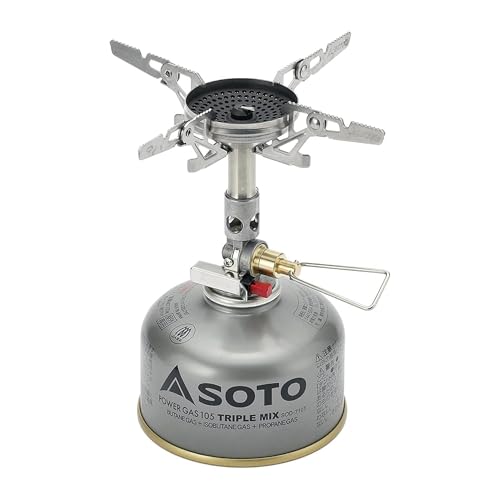
SOTO WindMaster with 4Flex
The recessed burner head keeps the flame lit in wind that blows out every other canister stove, and the micro regulator holds output as the canister cools. That is a real fuel saving on an exposed ridge, not a spec sheet claim.
Best for: Alpine and desert trips where there is no sheltered spot to cook, and late season use in the cold.

Jetboil Stash Cooking System
A heat exchanger pot plus stove that nests into itself and still comes in around seven ounces for the whole system. Compare the system weight, not the stove weight, before you decide this is heavy.
Best for: Cold weather and short fuel windows, where boiling faster on less gas is worth the bulk.
Weights are the manufacturer's listed figures. Prices and stock change constantly, so confirm on the retailer page. We earn commissions from Backcountry and from qualifying Amazon purchases. Cottage gear sold direct earns us nothing and is listed anyway.
What are the real differences at the trailhead?
Weight is the argument people have. Behaviour is what actually decides the trip.
Alcohol is slow. A canister stove brings two cups to a rolling boil in roughly three to four minutes. An alcohol burner takes closer to eight to twelve, and you cannot rush it. On a warm evening that is a non issue. Standing in wind at 38 degrees Fahrenheit waiting for water while your hands stop working, it is a real one.
The alcohol flame is nearly invisible in daylight. Denatured alcohol burns pale blue and in bright sun you often cannot see it at all. People reach across lit stoves, refill burners they believe are out, and knock over a cup of burning liquid they could not see. This is the single most common way alcohol stoves cause injuries and it is a genuine reason many people will not use one.
Alcohol cannot be turned off. Once lit, an alcohol burner runs until the fuel is gone or you smother it with a snuffer. There is no valve. A canister stove is off the instant you turn the knob, which matters when the pot tips, when the wind changes, or when a ranger asks you to extinguish it.
Alcohol is poor in wind and poor in cold. The windscreen is not optional, it is structural, and even with one a gust will steal most of your heat. Cold fuel is harder to light and burns lazier.
Canister stoves lose pressure in the cold. Isobutane blends vaporise less readily as the canister cools, and the canister also cools itself as it runs. Below roughly freezing you get noticeably weaker output, and by the time you are well below that you need a regulated stove, a canister kept warm in your quilt overnight, or a different fuel entirely. The SOTO WindMaster with 4Flex is the answer here: a recessed burner head that stays lit in wind that kills other canister stoves, plus a micro regulator that holds output as the canister cools. Cold weather planning is covered in the winter backpacking gear list.
Canister fuel cannot be gauged reliably. You cannot see inside, floating it in water is approximate, and shaking it tells you only that some liquid remains. The fix is to weigh canisters at home and write the gross weight on the side, since an empty 110 gram canister tares around 3.9 ounces and the difference is your remaining gas. It is also why so many people carry a half used canister plus a fresh one and lose the entire weight argument by accident.
Fire safety and legality, read this before choosing alcohol. Alcohol stoves are open flame devices with no shut off valve, and many land management agencies prohibit exactly that class of stove during fire restrictions while continuing to permit canister stoves, which can be extinguished instantly with a valve. Some jurisdictions restrict alcohol and solid fuel stoves regardless of season. Restrictions change through the year and vary between adjacent units, so check the managing agency for every section you will walk, every trip, and carry a backup plan that does not require a flame. A spilled cup of burning alcohol spreads across duff faster than you can react and the flame may be invisible while it does it. Never refill a burner that has been lit until it is fully cold, never operate any stove inside a tent or vestibule, and treat carbon monoxide from any stove in an enclosed space as lethal rather than unpleasant.
Is cold soaking a real option or an internet stunt?
It is real, it is common on long trails, and it is the only approach that wins the weight argument at every single trip length. Cold soaking means putting dried food and cold water in a sealed wide mouth jar, walking for a couple of hours, and eating what has rehydrated. Couscous, instant refried beans, ramen, instant mashed potato, instant rice, oats and most dried fruit all work. Freeze dried meals designed for boiling water work far less well and take much longer.
What you delete is the whole system: stove, pot, fuel, windscreen, lighter, and the daily ritual of cooking. What you keep is a jar and a long handled spoon, roughly 2 to 3 ounces, flat forever. On a ten day carry that is nearly a pound and a quarter saved against alcohol, and it is a pound saved against canister.
The costs are not weight costs. Texture is worse and it stays worse. Your menu narrows, which makes hitting a calorie density target harder, and the target matters: aim for 100 to 125 calories per ounce, with about 110 realistic for a mixed resupply. The calories per ounce reference shows which foods actually clear that bar cold. Morning coffee becomes cold coffee or no coffee. And there is a genuine safety dimension in cold and wet conditions, because a hot drink and a hot meal are a real tool for a hiker who has got chilled, and cold soaking removes that tool from your kit. Plan the food side properly with the ultralight food planning guide before you commit.
Who should choose each system?
Choose a canister stove if you want the decision to be boring, which most people should. It lights in a second, boils in three to four minutes, turns off with a valve, works in wind with a bit of shelter, and stays legal under fire restrictions that ban open flame stoves. It is the right answer for long carries, for anyone cooking for two, for cold and shoulder season trips, and for anybody who is new enough that they should not also be managing an invisible flame. The stove roundup covers the specific models.
Choose alcohol if your trips are one to three nights, you resupply often, you hike where fire restrictions are not a recurring problem, and you value simplicity with no moving parts and nothing to fail. Alcohol fuel is also available in hardware stores and gas stations almost everywhere, which is a real advantage in places where canisters are hard to find. Accept that you are trading speed, wind performance and legal flexibility for a few ounces on short trips.
Choose cold soaking if you are already comfortable in the backcountry, your trips are warm, and you have honestly tested the food at home before committing to it for a week. It suits high mileage summer hiking where you would rather eat while walking than stop and cook. It suits nobody who is cold, tired and new.
What about the integrated systems?
The comparison above is deliberately unfair to one option. The Jetboil Stash Cooking System is published at 7.1 ounces for the stove and heat exchanger pot together, which sounds heavy next to a 2.6 ounce burner until you remember that the burner has no pot. Against a PocketRocket 2 plus a TOAKS 750ml pot at a combined 6.2 ounces, the Stash costs under an ounce for a heat exchanger that measurably cuts the gas needed per boil. On a long cold carry that fuel saving can pay for the extra ounce and then some, and it is a good example of why system weight is the only honest unit of comparison.
At the other end, the BRS 3000T exists because it costs under twenty dollars and weighs under an ounce. Its pot supports are small, it does not simmer, and it is poor in wind, so it wants a windscreen and a pot under a litre. Used inside those limits it is the cheapest way to own a functioning cook system, and it appears in more sub 10 pound gear lists than anything else in the category.
What is the honest case against the canister stove?
Three things, and none of them are weight.
The canister is not recyclable through normal channels and the disposal problem is real. Empty canisters need puncturing and separating in the small number of places that accept them, and a great many end up in trailhead bins or, worse, in fire rings. Alcohol has no such waste stream, and a refillable fuel bottle is genuinely the cleaner system.
Availability is a planning constraint. Canisters cannot be posted in a resupply box and cannot be flown with, so every canister you use must be bought locally, and small trail towns run out. Alcohol can be decanted from a gas station bottle in any quantity.
You almost always carry more gas than you need. The step function that makes canister weight flat on a long carry also means that on a six day trip with a 230 gram canister you are carrying several ounces of fuel you will never burn, plus a steel and brass container you cannot make lighter as it empties. Alcohol gets lighter every day. That is a small pleasure and it is not nothing.
None of that reverses the recommendation for most people on most trips. It does mean the canister stove wins on convenience, speed and legality rather than on elegance.
How should you actually decide?
Answer four questions in order.
First, how many boils, not how many days. Count what you will actually heat. Two a day is normal, one a day is common, and hikers who eat cold lunches and drink cold water are often at one. That number, multiplied out across your longest carry, sets the fuel side of every system above.
Second, check the fire restrictions for every unit you will cross, for the season you are going. If open flame stoves are restricted anywhere on your route, the alcohol decision is already made for you.
Third, look at the cold. If your nights are meaningfully below freezing, take a regulated canister stove, sleep with the canister, and stop considering alcohol. If your nights are warm and your trips are short, alcohol is on the table.
Fourth, be honest about food. Cold soaking saves the most weight of any option on this page and it is the only one that also changes what you eat every day for the whole trip. Test it at home for a week before you take it somewhere remote.
One closing point that applies whichever way you go. Going ultralight must not mean going unprepared. A stove is a comfort item on a warm three day trip and a safety item on a cold wet one, and the difference between those two trips can be a single afternoon of weather. You are responsible for carrying what the conditions you will actually meet require, not what the forecast promised at the trailhead. Shelter, insulation, rain gear, navigation, water treatment and a way to call for help are fixed costs. Save the grams somewhere else.
Frequently asked questions
How many meals does a 110 g canister actually cover?
A 110 gram isobutane canister weighs about 7.8 ounces full, holds about 3.9 ounces of gas, and delivers roughly a dozen two cup boils in mild conditions with a windscreen. At two boils a day, dinner and morning coffee, that is about six days for one person. Wind, cold and simmering all cut it, sometimes by a third, so treat twelve as the ceiling rather than the plan.
Is an alcohol stove lighter than a canister stove?
The burner is, the system often is not. A denatured alcohol burner can weigh under an ounce, but it needs a windscreen, a pot stand and a fuel bottle, which brings the stove side to roughly the same weight as a canister stove. The difference is that alcohol fuel weight scales with every single boil, so the alcohol system gets heavier the longer the trip while the canister system stays flat until you need a bigger canister.
Where is the crossover point between alcohol and canister?
At two boils a day and roughly one fluid ounce of alcohol per boil, the canister system pulls level around day five and wins outright past about eight days. It is not a single clean point, because canister fuel comes in fixed steps while alcohol fuel is continuous. Short trips favour alcohol, long carries between resupply favour canister, and the honest answer depends on how many boils you actually do.
Are alcohol stoves banned anywhere?
Yes, frequently. Many agencies prohibit open flame stoves during fire restrictions while still permitting stoves with a shut off valve, which means a canister stove stays legal and an alcohol stove does not. Some jurisdictions restrict them year round. Check the managing agency for every section you will walk before you plan around alcohol, because a stove you are not allowed to light is dead weight and lighting it anyway is a serious offence.
Can you tell how much gas is left in a canister?
Not reliably in the field. Floating it in water gives a rough reading, shaking it tells you only whether liquid remains, and neither converts cleanly into boils. The practical answer is to weigh canisters at home with a small scale, write the current gross weight on the side in marker, and subtract the known empty tare. That turns a guess into a number and it is the single best habit in canister cooking.
Does cold soaking actually save meaningful weight?
It removes the entire cook system, which is roughly 7 to 15 ounces depending on the setup, plus every ounce of fuel for the whole trip. What remains is a wide mouth jar and a long handled spoon, about 2 to 3 ounces, and that figure never changes no matter how long the trip runs. The costs are texture, a narrower menu, no hot drink, and no way to warm yourself from the inside when conditions turn.
How we choose: we compare published manufacturer specifications, listed weights, and verified owner reviews across retailers. We do not test gear in person, and every weight quoted here is the manufacturer's figure unless we say otherwise, so weigh your own kit before you trust a total. Going lighter also means carrying less margin, so treat insulation, navigation, water treatment and an emergency plan as fixed costs rather than places to save grams.