Best Backpacking Water Filter for Ultralight Hikers
The Sawyer Squeeze ($45.95, 3.0 oz or 85 g) is the best backpacking water filter for most ultralight hikers. Hollow fibre filters rated to 0.1 micron remove bacteria and protozoa but not viruses, and a single freeze cracks the fibres with no visible sign, after which the filter must be replaced.
The Sawyer Squeeze at $45.95 and 3.0 oz (85 g) is still the filter to beat for most ultralight backpackers. It flows faster and clogs slower than the 57 g Sawyer Micro Squeeze for 28 g more, it threads onto a standard soda bottle so you can build any system you like around it, and it is the filter the long trails run on, which means spare parts exist in every trail town.
A water filter is a physical barrier that strains pathogens out of water by pore size, which is why it works instantly and why it has hard limits. Below are four filters across the price range, then the part of this page that actually matters: what these filters do not do, and how they fail.
Best backpacking water filters by experience level
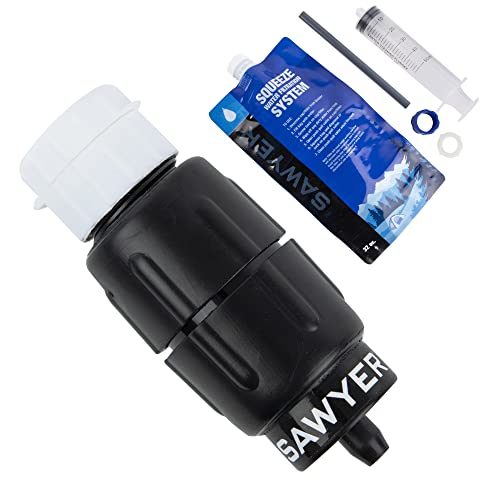
Sawyer Micro Squeeze Water Filtration System
Two ounces, threads straight onto a standard soda bottle, and rated to 0.1 micron. Flow is slower than the full size Squeeze and slows further as it clogs, so backflush it more often than you think you need to.
Best for: Solo hikers on clear water sources who are counting every ounce.

Sawyer Squeeze Water Filtration System
The full size Squeeze flows faster and clogs slower than the Micro for one extra ounce, and it is the filter the long trails run on. Sleep with it in your quilt below freezing or the fibres crack and it is scrap.
Best for: Almost everyone. This is the default answer in the category and has been for a decade.

Katadyn BeFree 1.0L Collapsible Filter Bottle
The fastest flow of any squeeze filter out of the box, and the soft flask packs down to nothing when empty. It also clogs faster in silty water and the flask is the failure point.
Best for: Clear alpine water and anyone who hates standing at a creek squeezing a bag.

Platypus QuickDraw 1L Filter System
It can be backflushed by shaking rather than with a syringe, and it survives the cloudy desert sources that clog a Sawyer in a week. The included reservoir also runs as a gravity system in camp.
Best for: Desert trails, spring runoff, and any water you would describe as tan.
Weights are the manufacturer's listed figures. Prices and stock change constantly, so confirm on the retailer page. We earn commissions from Backcountry and from qualifying Amazon purchases. Cottage gear sold direct earns us nothing and is listed anyway.
What a hollow fibre filter does not protect you from
Read this before you plan a trip around any filter on this page.
- They remove bacteria and protozoa, not viruses. A 0.1 micron pore stops Giardia and Cryptosporidium comfortably. Viruses are an order of magnitude smaller and pass through. In most North American backcountry that is a reasonable risk, but where human contamination is plausible, or anywhere internationally, you need chlorine dioxide or a purifier rated for viruses on top of the filter.
- A single freeze destroys the filter and leaves no visible sign. Water inside the hollow fibres expands and cracks them. The cartridge looks identical, flows normally and no longer filters. There is no field test. If it froze, or if you are not certain it did not, it is scrap. Below freezing you sleep with it in your quilt and carry it inside a jacket during the day, and you do that on the first cold night, not the third.
- Backflush on a schedule, not on symptoms. Flow falls off gradually and a badly clogged cartridge is much harder to recover than a mildly loaded one. Nightly on silty water, every few days on clear water.
- Never plan a trip around one method of treatment. Filters clog, freeze, get dropped and get left at a spring. Carry a backup that fails differently: a few chlorine dioxide tablets weigh almost nothing and cannot crack in the cold.
Chlorine dioxide is the standard backup, and the reason it is a backup rather than a primary is time. It needs about 30 minutes for most pathogens and up to 4 hours for Cryptosporidium, so you dose a bottle at the source and drink from it later. Cold water and cloudy water both push those times longer, which is exactly the situation where you least want to wait. Full detail on the trade sits in our water treatment guide and in filter versus chemical water treatment.
Exactly what the cold weather protocol looks like
People nod at "do not let it freeze" and then lose a filter anyway, because the failure happens while they are asleep. Here is the version that works. At camp, the filter goes inside your quilt or sleeping bag, near your torso, not in the vestibule and not in the pack. Shake it out first so there is as little water in the fibres as possible, though understand that you cannot dry a hollow fibre cartridge and there will always be some left.
On trail on a cold day, it lives in an inside jacket pocket rather than a hip belt pocket, and the same goes for the drinking hose if you run an inline setup. In the car on the way home, it comes inside with you. The freeze that kills most filters is the overnight one in a car boot after the trip, on gear nobody is thinking about any more.
If a freeze happened or might have happened, replace the cartridge. There is no visual check, no flow test and no taste test that will tell you, because a cracked fibre still passes water happily. This is the one place where the ultralight instinct to save money is exactly wrong, and it is why carrying chlorine dioxide as a genuine backup, rather than as a token, matters most in shoulder season and cold weather ultralight trips.
How much does two ounces of filter actually cost you?
Less than the water it sits next to. Water weighs 2.2 lb per litre, which is 35.3 oz or almost exactly 1,000 g, so the entire spread between the lightest and heaviest filter here is 37 g, or 3.7 percent of a single litre. That framing matters because the ultralight instinct is to buy the 57 g Micro Squeeze and then spend twenty minutes an evening fighting its slower flow.
The better lever is carrying less water, not owning a lighter filter. A filter that flows fast lets you drink at the source and carry a single litre between reliable water, and that decision is worth kilograms rather than grams: two litres you did not need to carry is 2,000 g, which is more than twenty times the weight of the entire filter. Work out your actual carry with the water carry calculator before you optimise the filter itself, and see water weight for the full table.
| Filter | Price | Weight (oz) | Weight (g) | Strength | Weak point |
|---|---|---|---|---|---|
| Sawyer Micro Squeeze | $33.95 | 2.0 oz | 57 g | Lightest, threads onto soda bottles | Slowest flow, clogs soonest |
| Katadyn BeFree 1.0L | $42.95 | 2.3 oz | 65 g | Fastest flow out of the box | Soft flask is the failure point |
| Sawyer Squeeze | $45.95 | 3.0 oz | 85 g | Best all round, parts everywhere | Needs a syringe to backflush well |
| Platypus QuickDraw 1L | $54.95 | 3.3 oz | 94 g | Shake to backflush, handles silt | Heaviest, and the priciest here |
What does the next tier up actually buy you?
Across this site we frame upgrades as grams saved per dollar spent, because that is the number that decides whether an upgrade is worth it. Water filters are the category that breaks the framing, and the break is instructive: every dollar you spend here makes your kit heavier, not lighter. You are buying flow rate and clog resistance, and you are paying in both money and grams.
| Step up from the Micro Squeeze | Extra cost | Grams added | Grams per dollar | What you actually buy |
|---|---|---|---|---|
| To the Katadyn BeFree 1.0L | $9.00 | +8 g | -0.89 | The fastest flow in the category out of the box |
| To the Sawyer Squeeze | $12.00 | +28 g | -2.33 | Slower clogging, faster flow, parts in every trail town |
| To the Platypus QuickDraw 1L | $21.00 | +37 g | -1.76 | Shake backflushing and real silt tolerance |
| For scale | Free | -1,000 g | Unbeatable | Carrying one litre less because your filter flows fast enough to drink at the source |
That footer row is the actual argument. The best filter is the one you will happily use at every source, because using it at every source is what lets you stop carrying water, and water is 1,000 g per litre against a 37 g decision. Buying the 57 g filter and then carrying an extra litre because squeezing it is tedious is a net loss of roughly 963 g.
The four filters, and who each one is really for
The Sawyer Micro Squeeze, $33.95, 57 g. The lightest option and the one that appears in the most aggressive gear lists. It uses the same 0.1 micron hollow fibre technology as its bigger sibling in a smaller housing, which means less fibre surface area, which means slower flow and earlier clogging. On clear alpine water with a disciplined backflush habit it is genuinely fine. On silt it turns into a chore within a week.
The Sawyer Squeeze, $45.95, 85 g. The default. The extra 28 g buys more fibre, which buys flow and longevity, and the ubiquity buys you something less tangible: if you break a coupling or lose a bag in a trail town, somebody has a spare. It backflushes properly with the included syringe, which is the one part people leave at home and then wish they had not. It threads onto standard bottle necks, so you can run it squeeze, gravity or inline without buying anything else.
The Katadyn BeFree 1.0L, $42.95, 65 g. The fastest flow you can buy out of the box, and the reason people love it is that filling feels effortless for the first few weeks. Two caveats. It clogs faster in silty water than the Sawyers, and the soft flask is the failure point: the seams and the neck take abuse from being stuffed into a pack, and a flask failure is a system failure rather than a cartridge failure. Carry the knowledge that the flask, not the filter, is what will end its life.
The Platypus QuickDraw 1L, $54.95, 94 g. The specialist. It backflushes by shaking rather than with a syringe, which sounds like a convenience feature until you are on a desert trail where every source is tan and you are recovering flow twice a day. The included reservoir also runs as a gravity system in camp with no extra hardware, which is the fastest way to fill four litres for a group. It is the heaviest filter here by 37 g over the Micro, and that is the price of robustness.
Squeeze, gravity or inline, which system should you build?
The cartridge is only half the decision. Squeeze is the default: fill a dirty bag, thread the filter on, squeeze into a clean bottle. It is fast, it needs no setup, and it means standing at the water with your hands occupied. It is also hardest on the dirty bag, which is the component most likely to split at a seam.
Gravity hangs a dirty reservoir from a branch and lets it drip through while you set up camp. It is the right answer for groups and for anyone filling four litres at a time, and the QuickDraw reservoir runs this way without extra parts. The cost is that you need somewhere to hang it, which above treeline is not a given.
Inline puts the filter in a hydration hose so you drink filtered water as you walk, which is the fastest of all and the hardest to backflush. It is also the setup most likely to freeze overnight, because the filter lives in the pack rather than in your quilt, and it is the setup where a clog is least visible: you simply find yourself sucking harder each day until you stop drinking enough.
Who should not buy the expert pick
It is also the wrong first filter for someone who has not yet worked out where they hike, because the Sawyer thread standard gives you far more ways to reconfigure the system later, and far more chance that the hiker next to you has the part you broke. Buy the QuickDraw when you can name the tan-coloured water source that made you want it, which in practice means after a desert trip or a spring runoff season has already ruined one filter for you.
Habits that make a filter last
- Collect from the cleanest part of the source. Mid-current and off the bottom, never stirred-up shallows, because every gram of silt you avoid is flow you keep.
- Pre-filter visibly dirty water. A bandana over the mouth of the dirty bag catches the coarse material that does most of the clogging, and it weighs nothing you were not already carrying.
- Keep dirty and clean separate. One bag and one bottle, labelled and never swapped. Recontaminating a clean bottle at the threads is the most common way people get sick with a working filter.
- Backflush before it feels slow. Nightly in silt, every few days in clear water.
- Sleep with it below freezing. Inside the quilt, not in the vestibule and not in the pack.
- Carry chemical backup. A few tablets, always, because they fail in completely different ways to a filter.
- Replace after a suspected freeze. No exceptions, no field test, no hoping.
Related reading
- Water treatment guide: filters, chemicals, UV and what each one actually kills
- Filter versus chemical water treatment: weight, wait time and failure modes side by side
- Water carry calculator: how much to carry between reliable sources
- Water weight reference: 2.2 lb per litre and what that does to a pack
- Desert backpacking gear list: where silty water and long carries meet
- All gear reviews
Frequently asked questions
What is the best backpacking water filter?
The Sawyer Squeeze at $45.95 and 3.0 oz, or 85 g, is the default answer for most backpackers and has been for a decade. It flows faster and clogs slower than the smaller Micro Squeeze, it threads onto standard bottles, and replacement parts are stocked in trail towns everywhere. Pick the Platypus QuickDraw at $54.95 instead if your water sources are silty rather than clear.
Do hollow fibre filters remove viruses?
No. A 0.1 micron hollow fibre filter removes bacteria and protozoa, including Giardia and Cryptosporidium, but viruses are far smaller and pass straight through. In most of North America that is an acceptable risk profile. Where human contamination is likely, or when travelling internationally, add chlorine dioxide or a purifier rated for viruses rather than assuming the filter covers it.
What happens if a water filter freezes?
The water trapped inside the hollow fibres expands and cracks them, and the damage is invisible. The filter still looks fine, still flows, and no longer filters reliably. There is no field test that will tell you, so a filter that has frozen or may have frozen must be treated as scrap. Below freezing, sleep with the filter inside your quilt and carry it in a jacket pocket during the day.
How often should I backflush my filter?
More often than you think, and before the flow annoys you rather than after. Flow rate drops gradually as sediment loads the fibres, so most people only notice once it is badly clogged and harder to recover. Backflush at camp every evening on silty water and every few days on clear alpine water. A clogged filter is the most common reason people abandon one mid trip.
How long does chlorine dioxide take to work?
Around 30 minutes for bacteria and viruses in clear water at moderate temperatures, and up to 4 hours for Cryptosporidium, which is unusually resistant. Cold or cloudy water pushes those times longer. That waiting period is the practical drawback: chemical treatment is nearly weightless and immune to freezing, but you cannot drink at the source, so plan the dose one water carry ahead.
Do I need to filter clear alpine water?
Yes. Clarity tells you about sediment, not about pathogens, and Giardia cysts are invisible in a glass of water that looks perfect. Upstream grazing, pack animals and other hikers all put contamination into high, clean-looking drainages. Filter or treat everything, every time, and keep the habit consistent so you never have to make a judgement call while dehydrated.
How we choose: we compare published manufacturer specifications, listed weights, and verified owner reviews across retailers. We do not test gear in person, and every weight quoted here is the manufacturer's figure unless we say otherwise, so weigh your own kit before you trust a total. Going lighter also means carrying less margin, so treat insulation, navigation, water treatment and an emergency plan as fixed costs rather than places to save grams.