Backpacking Water Treatment: Filters, Chemicals and Boiling
A 0.1 micron hollow fibre filter removes protozoa and bacteria but not viruses, and a single freeze cracks the fibres with no visible sign. Chlorine dioxide covers viruses and bacteria but needs about 30 minutes for giardia and up to 4 hours for cryptosporidium. Boiling works at any elevation: 1 minute at a rolling boil, 3 minutes above 6,500 feet.
Water treatment is the one ultralight decision where the failure mode is illness rather than discomfort. The practical answer for almost everyone in North America is a 0.1 micron hollow fibre squeeze filter for daily drinking, plus chlorine dioxide tablets as a backup that weigh almost nothing and cover the one category of pathogen the filter misses. This guide covers what is actually in backcountry water, what each method removes, and the specific ways each method fails.
What is actually in backcountry water?
Four categories, and they have very different sizes, which is the whole reason no single method covers everything.
Protozoa are the realistic North American threat. Giardia lamblia and cryptosporidium are single-celled parasites shed in the faeces of mammals, including beaver, cattle, dogs and humans, and they survive in cold water for weeks. Giardia cysts are roughly 8 to 12 microns across and cryptosporidium oocysts roughly 4 to 6 microns, both far larger than a 0.1 micron filter pore, so filtration handles them completely. Chemicals are a different story: cryptosporidium has a thick oocyst wall that resists chlorine-based treatment for hours, which is why it drives the longest contact time on any tablet label.
Bacteria are the next tier down, roughly 0.2 to 5 microns. E. coli and campylobacter are the names that come up most, and both arrive by the same route as the protozoa: something upstream defecated in or near the drainage. Bacteria are removed by any 0.1 micron filter and killed by every chemical treatment and by boiling.
Viruses are the awkward category. Norovirus, hepatitis A and rotavirus measure roughly 0.02 to 0.3 microns, which means they pass through a hollow fibre filter as though it were not there. In remote North American backcountry the risk is genuinely low, because the waterborne viruses that matter are human-specific and the density of humans upstream is low. That reasoning fails in three situations that people meet more often than they think: travel outside North America, heavily used drainages below popular campsites and stock routes, and agricultural valleys where irrigation return flow enters the creek. In those places viruses are a real risk and you need chemicals, ultraviolet light or heat.
Sediment and dissolved chemicals are the fourth category and are not a health threat in most places, with the important exception of mine drainage and agricultural runoff. Nothing on this page removes dissolved metals or nitrates. If you are hiking below abandoned mine workings or through irrigated farmland, the answer is to choose a different source rather than a different filter.
Does clear, fast moving water mean anything?
No, and this belief causes more illness than any equipment failure. Clarity is a measure of suspended particles large enough to scatter light. Every pathogen listed above is far below that threshold, so a source can be gin clear and loaded. Movement is no better as a signal: a fast creek carries contamination downstream quickly, which helps the water a mile below the source and does nothing for you standing at the point where a marmot died in the inlet.
What does carry real information is what is upstream. A spring emerging from rock with no catchment above it is genuinely low risk. A creek draining a basin with a popular campsite, a stock trail or grazing allotment above it is high risk regardless of how it looks. Read the topography, not the water.
Which method removes what?
Every choice below is a trade between what it removes, how long it takes and how it fails. The failure column is the one people skip and the one that matters.
| Method | Protozoa | Bacteria | Viruses | Sediment | Chemicals | Weight | Time per litre | Cost | In the cold | How it fails |
|---|---|---|---|---|---|---|---|---|---|---|
| Hollow fibre squeeze, 0.1 micron | Yes | Yes | No | Partly | No | 2.0 to 3.3 oz | 1 to 3 min | $34 to $55 | Destroyed by one freeze | Clogs, then cracks unseen after freezing |
| Gravity system | Yes | Yes | No | Partly | No | 8 to 12 oz | 2 to 4 min | $70 to $130 | Destroyed by one freeze | Hose splits, dirty bag punctures, flow stalls |
| Pump filter | Yes | Yes | No | Yes | Some carbon models | 11 to 16 oz | 1 to 2 min | $90 to $150 | Cartridge destroyed by one freeze | Seals and O rings, pump handle, clogged cartridge |
| Chlorine dioxide tablets or drops | Yes, up to 4 h for crypto | Yes | Yes | No | No | 0.5 to 1.5 oz | 15 to 240 min wait | $10 to $15 | Works, but every contact time lengthens | Expired product, opened bottle life, impatience |
| Iodine tablets | Giardia yes, crypto no | Yes | Yes | No | No | 1 oz | 30 min wait | $8 to $12 | Poor, needs much longer contact | No crypto coverage, taste, medical restrictions |
| Ultraviolet pen | Yes | Yes | Yes | No | No | 3 to 5 oz | 60 to 90 sec | $90 to $130 | Battery output drops sharply | Dead battery, cloudy water shadowing, broken lamp |
| Boiling | Yes | Yes | Yes | No | No | Fuel only | 5 to 10 min | Fuel cost | Works, but uses more fuel | Out of fuel, no time, hot water to drink |
| Filter plus chemical backup | Yes | Yes | Yes, via the tablets | Partly | No | 3 to 4 oz | 1 to 3 min normally | $45 to $60 | Backup survives what the filter does not | The recommended combination for three season use |
How do hollow fibre squeeze filters work, and how do they fail?
Inside the housing is a bundle of hollow plastic fibres perforated with pores of a stated absolute size, normally 0.1 micron. Dirty water is forced through the fibre wall, anything larger than the pore stays outside, and clean water collects in the lumen and exits. Absolute rating matters here: it means no pore is larger than the stated size, as opposed to a nominal rating which is an average and lets larger pores through.
The Sawyer Squeeze at 3.0 oz is the default in this category and has been for a decade. The Sawyer Micro Squeeze saves an ounce and pays for it in flow rate. The Katadyn BeFree flows faster than either out of the box and clogs sooner in anything but clear water.
There are three failure modes and only one of them is visible. The first is clogging. Flow degrades continuously from the first litre, not suddenly at the end of life, so a filter that takes twice as long as it used to is already half throttled. Backflushing pushes clean water back through the fibres and restores most of the flow. Do it at the end of each day rather than waiting until the filter is unusable, because compacted silt eventually stops responding to backflushing at all.
The second is freezing, covered in its own section below, and it is invisible. The third is mechanical damage: a dropped filter, a cracked housing, or the soft flask on a bottle-style unit splitting at the seam. Carry the filter where it will not be crushed, and treat the flask as the consumable part of the system.
What about gravity and pump filters?
A gravity system is the same filter element with a dirty reservoir hung above it and a clean reservoir below, so head pressure does the work while you set up camp. For a group it is the obvious answer, because filtering six litres by squeezing is a chore and filtering six litres by hanging a bag is not. The cost is 8 to 12 ounces of bags and hose, plus a longer list of parts that can split. The Platypus QuickDraw runs as a squeeze filter or, with its reservoir, as a simple gravity setup, which is a reasonable way to cover both cases without carrying two systems.
Pump filters are the heaviest option at 11 to 16 ounces and they still earn their place in two situations: shallow sources where you cannot submerge a bag, and genuinely dirty water where a pre-filter on the intake hose does most of the work before the cartridge sees it. Some pump models include a carbon element, which improves taste and adsorbs some organic chemicals, though carbon does not make agricultural or mine-affected water safe.
How long does chemical treatment take?
Chlorine dioxide is the chemical worth carrying. It is generated when you mix two drops or drop in a tablet, it kills bacteria and viruses quickly, and unlike chlorine and iodine it does eventually inactivate cryptosporidium. Eventually is the operative word. The times below are the guidance commonly printed on tablet and drop labels, and the specific product you buy is the authority, not this table.
| Organism | Warm water, about 68F | Cold water, about 40F | Why the difference |
|---|---|---|---|
| Bacteria, including E. coli | 15 min | 30 min | Thin cell wall, fastest to inactivate |
| Viruses, including norovirus | 30 min | 60 min | Small but chemically vulnerable |
| Giardia cysts | 30 min | 60 min | Cyst wall slows penetration |
| Cryptosporidium oocysts | 240 min | 240 min or more | Thick oocyst wall, the reason for the 4 hour figure |
| Practical rule | 4 h | 4 h | Dose at collection, drink at the next stop, and the wait costs you nothing |
Two things follow from that table. First, cold water lengthens every contact time, and snowmelt in spring is colder than most people assume. Second, the 4 hour figure is only a problem if you dose when you are thirsty. Dose two litres at the morning source, hike, and the wait has already elapsed by lunch.
Chlorine dioxide leaves a mild taste that most people stop noticing. It does not remove sediment, it does not remove tannins, and it has a shelf life. Tablets are individually foil sealed and keep for years. Two-part liquid drops have a much shorter life once the bottle is opened, so label the bottle with the year and replace it rather than gambling. Compare the two approaches side by side in the filter versus chemical comparison.
Is iodine still worth carrying?
Rarely. Iodine kills bacteria and viruses and inactivates giardia given enough time, but it is not effective against cryptosporidium at any practical dose or wait, which removes half the protozoan threat it is supposed to cover. It also stains, it tastes strongly of itself, and it carries real medical restrictions: iodine treatment is not appropriate for people who are pregnant, people with thyroid conditions, or anyone with a known iodine sensitivity, and it is not intended for continuous long-term use. Chlorine dioxide does the same job better and weighs the same. Treat iodine as a legacy option you might find in an old kit rather than something to buy.
Do ultraviolet pens work?
Yes, under conditions. Ultraviolet light scrambles the DNA of protozoa, bacteria and viruses so they cannot reproduce, and it does it in 60 to 90 seconds per litre with no taste and no waiting. That is the best coverage-to-time ratio of anything on this page.
The conditions are the problem. The water must be visually clear, because suspended particles cast shadows and a pathogen in a shadow is untreated. The pen needs working batteries, and battery output falls in the cold exactly when a filter has already frozen and failed. The lamp is glass. And nothing about the process is verifiable in the field: you cannot see whether the dose was adequate. For a hiker who filters silty desert water, a pen is the wrong tool. For a traveller drinking clear tap water of uncertain viral quality, it is a very good one.
When should you just boil it?
Boiling is the oldest method and the only one that needs no dedicated equipment, because you are already carrying a stove and a pot. It kills protozoa, bacteria and viruses without exception. A rolling boil is effective at any elevation: the boiling point falls as you climb, but it stays far above the temperature that inactivates waterborne pathogens. The commonly cited guidance is 1 minute at a rolling boil, extended to 3 minutes above 6,500 feet as a margin of safety.
The costs are fuel, time and temperature. Boiling every litre for a multi-day trip burns fuel faster than any realistic canister budget supports, and you end up with hot water in a warm climate. Where boiling genuinely wins is winter, when filters freeze and chemical contact times stretch, and you are melting snow for water anyway. See the winter gear list for how that changes the rest of the kit.
Why is a frozen filter scrap rather than a maybe?
Because water expands about 9 percent when it freezes, and the fibres holding your treated water apart from your untreated water are thin plastic walls with 0.1 micron holes in them. Residual water inside the element freezes, the ice widens the pores and splits fibres, and the damage is invisible from outside. The housing is intact. The filter still flows, sometimes faster than before, which is precisely the wrong reassurance. There is no field test that will tell you whether it is still filtering.
So the rule is absolute: if a hollow fibre filter has frozen, retire it. Not "probably fine", not "it was only one night". This applies to squeeze filters, gravity elements and pump cartridges equally. On any trip where the overnight low is near or below freezing, get the filter out of the pack and sleep with it inside your quilt, and carry it inside a jacket pocket during the day if the daytime temperature stays below freezing. A filter left in a car boot over winter is the other common way people destroy one without noticing.
What do you do with silty or tannic water?
Pre-filter it or settle it, because silt is what kills hollow fibre filters fastest. Fine suspended clay packs into the fibre bundle, flow collapses within a few litres, and eventually backflushing stops recovering it. Desert washes, glacial melt, spring runoff and stock ponds are all in this category.
Three techniques, in order of effort. Collect carefully: scoop from just below the surface with the mouth of the bag facing sideways, never from the bottom, and dig a small hole beside a silty stream so water seeps in through the gravel. Settle it: fill the dirty bag at camp and leave it upright for an hour, then decant the clear upper portion and tip the sludge out. Pre-filter it: pour through a bandana, a coffee filter or a dedicated pre-filter into the dirty bag before it reaches the element. None of these treat the water. They only protect the thing that does.
Tannic water, the tea-coloured water of bog and swamp drainages, is a different problem. Tannins are dissolved and no filter on this page removes them. They are not a health threat and they will not clog anything. The water simply tastes of the forest floor. Desert planning has its own set of constraints, and the desert gear list covers carrying capacity and source spacing alongside treatment.
What actually makes people sick out there?
Hands, mostly. Studies of backcountry illness keep landing on the same conclusion: person to person transmission through poor hand hygiene and shared food explains far more cases than untreated water does. Norovirus tears through shelters and huts on long trails every season and it does not arrive by creek, it arrives by hand.
The second route is cross-contamination at the moment of treatment. You collect from the source, the outside of the dirty bag and the bottle threads are wet with untreated water, and you then drink from those threads. The filter did its job perfectly and you drank around it. The fixes are small and free: keep one bottle permanently dirty and one permanently clean and never confuse them, wipe or shake the threads of the clean container, do not let the clean outlet touch the dirty bag, and wash or sanitise your hands after every toilet stop and before every meal. Alcohol gel is a partial answer only, because it is weak against norovirus and cryptosporidium, so soap and water 200 feet from any source is still the standard.
How much water should you carry between sources?
That is a weight question as much as a safety one. Water weighs 2.2 lb per litre, which is more than most single items in an ultralight kit, so the difference between carrying one litre and carrying four is 6.6 lb on your back. The discipline is to carry the minimum that gets you to the next reliable source with a margin, not to fill every bottle at every creek.
Work it out rather than guessing. The water weight chart gives the conversions, and the water carry calculator takes your source spacing, pace and temperature and returns a litre figure. In hot or dry conditions plan a margin, because the cost of an extra half litre is 1.1 lb and the cost of running dry is your trip.
What should you actually carry?
For three season North American hiking: a 2 to 3 ounce hollow fibre squeeze filter, a strip of chlorine dioxide tablets, two 1 litre bottles with one designated dirty, and a backflush routine at the end of each day. That system weighs under 6 ounces including bottles, costs under $60, and covers every realistic threat provided you use the tablets when the filter is compromised.
Change it in three situations. Below freezing, the filter sleeps with you and the tablets become the primary method. In heavily used, agricultural or international water, chemicals or heat go on top of the filter rather than beside it. In silty water, add a pre-filter and expect to replace the element sooner. The water filter roundup compares the specific models by flow, weight and how they behave when the water is not clear.
Water filters by experience level
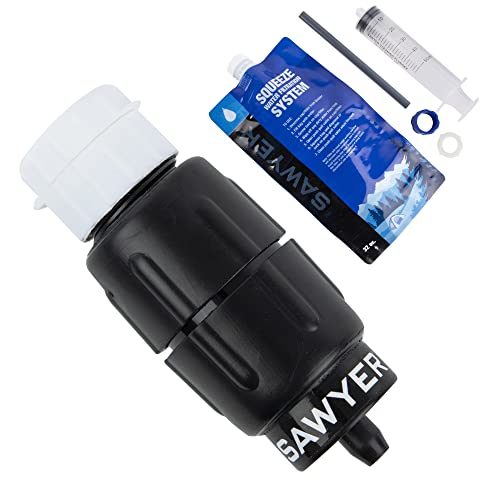
Sawyer Micro Squeeze Water Filtration System
Two ounces, threads straight onto a standard soda bottle, and rated to 0.1 micron. Flow is slower than the full size Squeeze and slows further as it clogs, so backflush it more often than you think you need to.
Best for: Solo hikers on clear water sources who are counting every ounce.

Sawyer Squeeze Water Filtration System
The full size Squeeze flows faster and clogs slower than the Micro for one extra ounce, and it is the filter the long trails run on. Sleep with it in your quilt below freezing or the fibres crack and it is scrap.
Best for: Almost everyone. This is the default answer in the category and has been for a decade.

Katadyn BeFree 1.0L Collapsible Filter Bottle
The fastest flow of any squeeze filter out of the box, and the soft flask packs down to nothing when empty. It also clogs faster in silty water and the flask is the failure point.
Best for: Clear alpine water and anyone who hates standing at a creek squeezing a bag.

Platypus QuickDraw 1L Filter System
It can be backflushed by shaking rather than with a syringe, and it survives the cloudy desert sources that clog a Sawyer in a week. The included reservoir also runs as a gravity system in camp.
Best for: Desert trails, spring runoff, and any water you would describe as tan.
Weights are the manufacturer's listed figures. Prices and stock change constantly, so confirm on the retailer page. We earn commissions from Backcountry and from qualifying Amazon purchases. Cottage gear sold direct earns us nothing and is listed anyway.
Frequently asked questions
Do I need to treat clear mountain water?
Yes. Clarity tells you about suspended sediment and nothing about pathogens. Giardia cysts and cryptosporidium oocysts are microscopic, they do not cloud water, and they arrive from animals and people upstream of a source that looks pristine. Fast moving water is not self-cleaning either, it simply carries contamination past you faster. Treat every source you drink from unless you are standing at a tested and posted potable tap.
Does a hollow fibre water filter remove viruses?
No. A 0.1 micron hollow fibre filter such as the Sawyer Squeeze removes protozoa and bacteria, which covers the realistic North American threats, but viruses are roughly ten to a hundred times smaller than the pore size and pass straight through. Where viruses are a genuine concern, meaning most travel outside North America and heavily used or agricultural drainages anywhere, you need chlorine dioxide, ultraviolet light or boiling in addition to or instead of the filter.
What happens if my water filter freezes?
It is scrap, and you cannot tell by looking. Water left inside the hollow fibres expands as it freezes and cracks them, opening channels wider than the pathogens the filter is supposed to stop. The housing looks perfect, the filter still flows, and it no longer filters. There is no field test. If a filter has frozen, retire it. Below freezing, sleep with the filter inside your quilt.
How long do chlorine dioxide tablets take to work?
Label guidance is commonly 15 minutes for bacteria, 30 minutes for viruses and giardia, and up to 4 hours for cryptosporidium, which is the slowest organism to kill because of its thick-walled oocyst. Cold water lengthens every one of those times, and near freezing you should roughly double the shorter waits. Start the treatment when you collect, not when you want to drink, and follow the specific product label.
Is boiling water enough at high elevation?
Yes. Water boils at a lower temperature as elevation rises, but a rolling boil is still hot enough to inactivate protozoa, bacteria and viruses. The commonly cited guidance is 1 minute at a rolling boil, extended to 3 minutes above 6,500 feet as a margin of safety. Boiling removes nothing physical, so silt, tannins and chemical contamination stay exactly where they were.
What is the lightest safe way to treat water?
Chlorine dioxide tablets, at well under an ounce for a multi-day supply, and they cover viruses that a filter does not. The trade is waiting time and taste. The lightest practical system for most people is a 2 to 3 ounce squeeze filter for daily drinking plus a strip of tablets as backup, because a filter is a single point of failure and the backup weighs almost nothing.
How we choose: we compare published manufacturer specifications, listed weights, and verified owner reviews across retailers. We do not test gear in person, and every weight quoted here is the manufacturer's figure unless we say otherwise, so weigh your own kit before you trust a total. Going lighter also means carrying less margin, so treat insulation, navigation, water treatment and an emergency plan as fixed costs rather than places to save grams.