Filter vs Chemical Water Treatment: Carry Both
The correct answer is both. A hollow fibre filter rated 0.1 micron absolute removes bacteria and protozoa but does not remove viruses, and a single freeze cracks the fibres with no visible sign, which makes any filter a single point of failure. Chlorine dioxide kills bacteria and viruses but needs long contact time against cryptosporidium, commonly cited as up to 4 hours, and all contact times lengthen in cold water. Carry a filter for daily use and chemical tablets as a backup on every trip.
This is the one comparison on the site with a safety answer rather than a preference answer, so here it is up front: carry both. A filter is what you use every day because it is fast and the water tastes like water. Chemical tablets are what you carry because a filter is a single point of failure and it fails in ways you cannot see. The two methods also cover different organisms: a hollow fibre filter removes bacteria and protozoa but does not remove viruses, while chlorine dioxide kills viruses and bacteria quickly but needs up to 4 hours against cryptosporidium. Neither is complete. Together they are, and the combined weight penalty is under an ounce.
How does a hollow fibre filter actually work?
A hollow fibre filter is a physical sieve, not a chemical process. Inside the housing sit thousands of hair thin tubes whose walls are perforated with pores of a controlled size. Water is pushed through the wall of each tube and out the other end. Anything physically larger than the pore cannot pass. The common backpacking specification is 0.1 micron absolute, where absolute means the largest pore, not the average, which is the number that matters.
Line the organisms up by size and the specification explains itself. Protozoan cysts such as Giardia and Cryptosporidium are roughly 4 to 15 micron and 4 to 6 micron respectively, which is enormous next to a 0.1 micron pore. Bacteria such as E. coli and Campylobacter are roughly 0.5 to 3 micron, still comfortably excluded. Viruses are roughly 0.02 to 0.3 micron, which straddles and undercuts the pore size. That is the entire reason a backpacking filter is not a virus filter. It is not a manufacturing shortcut, it is geometry.
Two consequences follow. First, a filter works instantly and completely for what it excludes, with no waiting and no dosing to get wrong. Second, its performance degrades as the pores load up with material, which is what clogging is, and a clogged filter is slow rather than unsafe. Backflushing pushes clean water the wrong way through the fibres to clear them, and it should be done far more often than most people bother to.
How does chemical treatment work, and why the wait?
Chlorine dioxide, sold as tablets or as a two part liquid, works by oxidising the organism rather than straining it out. Because it is a chemical reaction it does not care about size, which is why it handles viruses that walk straight through a filter. But a reaction takes time, and how much time depends on which organism, how cold the water is, and how much other material in the water is consuming the chemical.
Label directions commonly give roughly 15 to 30 minutes for bacteria and viruses, and up to 4 hours for Cryptosporidium, whose thick oocyst wall makes it the hardest common organism to inactivate. Every one of those times lengthens in cold water, which is exactly the water you are treating in the mountains, and lengthens further in cloudy water. Iodine is a separate chemistry with its own limits: it is not considered effective against Cryptosporidium at practical field doses, it leaves a strong taste, and it is not appropriate for prolonged use or for people with thyroid conditions or who are pregnant.
The practical failure mode of chemicals is impatience. Nobody stands at a creek for four hours. People drop the tablet, wait the twenty minutes on the packet, and drink, which covers bacteria and viruses and does not cover crypto. That is a defensible risk in clear alpine water where crypto is unlikely, and a poor one in a valley where cattle graze. Always follow the specific product label rather than a general figure, and treat the four hour number as the real one when the source is suspect.
The three water rules that are not negotiable. One: a single freeze cracks hollow fibre with no visible sign, the filter still flows, and it is scrap. Below freezing, carry it inside a jacket pocket by day and inside your quilt at night, and replace any filter you think may have frozen rather than gambling on it. Two: carry a chemical backup on every trip, because a filter is a single point of failure and tablets for a week weigh under an ounce. Three: silty water clogs hollow fibre fast, so pre settle anything cloudy for twenty minutes to an hour and decant the clear water off the top before it touches the filter. Going ultralight must not mean going unprepared, and water treatment is a fixed cost, not a place to save grams.
How do the methods compare head to head?
The table below sets the four realistic approaches against each other on coverage first and convenience second, because coverage is the part that can hurt you. Weights are published manufacturer figures for the item named. Cost per litre is an order of magnitude estimate from typical retail pricing and manufacturer rated cartridge life rather than a measured figure.
| Method | Protozoa | Bacteria | Viruses | Sediment | Taste | Weight | Time per litre | Cost per litre | In the cold | Failure mode |
|---|---|---|---|---|---|---|---|---|---|---|
| Hollow fibre filter, 0.1 micron | Yes | Yes | No | Removes visible particles | Neutral, best of all | 2.0 to 3.3 oz | 1 to 3 min | Under $0.01 | Destroyed by one freeze | Clogs, freezes, gasket lost |
| Chlorine dioxide tablets | Yes, up to 4 hr on crypto | Yes, 15 to 30 min | Yes, 15 to 30 min | None | Mild chemical | 0.02 oz each | 30 min to 4 hr | $0.40 to $0.60 | Contact times lengthen | Waiting less than the label says |
| Chlorine dioxide drops, two part | Yes, up to 4 hr on crypto | Yes, 15 to 30 min | Yes, 15 to 30 min | None | Mild chemical | About 2 oz for the kit | 35 min to 4 hr | $0.05 to $0.15 | Contact times lengthen | Mixing and dosing errors |
| Boiling to a rolling boil | Yes | Yes | Yes | None | Flat, needs cooling | Cook system already carried | 5 to 8 min plus cooling | About $1.00 in fuel | Works, costs more fuel | Runs out of fuel |
| Filter plus chemical backup | Yes | Yes | Yes, when chemicals used | Removes visible particles | Neutral in daily use | 3.0 to 3.5 oz | 1 to 3 min normally | Under $0.01 normally | Chemicals cover a dead filter | Both would have to fail |
| Recommendation | Covered | Covered | Covered on demand | Pre settle regardless | Good | Under 1 oz added | Fast in normal use | Cheapest per litre | Redundant by design | No single point of failure |
Read the weight column and the failure mode column together. Adding tablets to a filter costs well under an ounce and converts a system with one point of failure into a system with two independent ones. There is no other decision in a backpacking kit where that little weight buys that much redundancy. For comparison, an ounce is less than half a litre of water, and water weighs 2.2 pounds per litre, which the water weight reference puts in context against everything else you carry.
Water filters: the four worth carrying
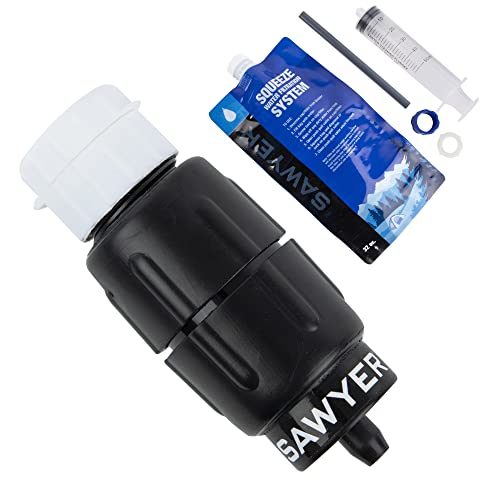
Sawyer Micro Squeeze Water Filtration System
Two ounces, threads straight onto a standard soda bottle, and rated to 0.1 micron. Flow is slower than the full size Squeeze and slows further as it clogs, so backflush it more often than you think you need to.
Best for: Solo hikers on clear water sources who are counting every ounce.

Sawyer Squeeze Water Filtration System
The full size Squeeze flows faster and clogs slower than the Micro for one extra ounce, and it is the filter the long trails run on. Sleep with it in your quilt below freezing or the fibres crack and it is scrap.
Best for: Almost everyone. This is the default answer in the category and has been for a decade.

Katadyn BeFree 1.0L Collapsible Filter Bottle
The fastest flow of any squeeze filter out of the box, and the soft flask packs down to nothing when empty. It also clogs faster in silty water and the flask is the failure point.
Best for: Clear alpine water and anyone who hates standing at a creek squeezing a bag.

Platypus QuickDraw 1L Filter System
It can be backflushed by shaking rather than with a syringe, and it survives the cloudy desert sources that clog a Sawyer in a week. The included reservoir also runs as a gravity system in camp.
Best for: Desert trails, spring runoff, and any water you would describe as tan.
Weights are the manufacturer's listed figures. Prices and stock change constantly, so confirm on the retailer page. We earn commissions from Backcountry and from qualifying Amazon purchases. Cottage gear sold direct earns us nothing and is listed anyway.
Which filter should you actually buy?
The default answer has been the same for a decade. The Sawyer Squeeze at a published 3.0 ounces flows faster and clogs slower than the smaller version, threads onto standard bottle necks, and is the filter the long trails run on. It is the one to buy unless you have a specific reason not to.
The Sawyer Micro Squeeze saves an ounce and gives up flow rate for it, and it slows further as it loads, so it suits solo hikers on clear sources who backflush religiously. The Katadyn BeFree has the fastest flow of any squeeze filter out of the box and a soft flask that packs to nothing, at the cost of clogging faster in silt and a flask that is the usual failure point. The Platypus QuickDraw is the one to take where the water is bad: it backflushes by shaking rather than with a syringe, it survives cloudy desert sources that clog other filters within a week, and the included reservoir runs as a gravity system in camp. If your trips look like the desert backpacking gear list, that is the filter and the pre settling routine is not optional.
Whichever you buy, the maintenance is the same: backflush at every reliable water source rather than when the flow annoys you, keep the clean side clean by never letting a dirty cap touch the output, and store it dry between trips. Full detail lives in the water treatment guide, and the filter roundup covers the specific models by use case.
Who should choose filter first, and who should choose chemicals first?
Filter first describes almost everyone hiking in North American backcountry. You are drinking three to six litres a day, you want it now, you want it to taste like nothing, and the dominant risks are protozoa and bacteria from wildlife and livestock. A filter does that in ninety seconds a litre with no dosing decisions and no waiting. Use the water carry calculator to work out how much you actually need to treat between sources, because the answer often surprises people and it changes which method is tolerable.
Chemicals first makes sense in four situations. Sustained sub freezing conditions, where a filter is a liability you must nurse rather than a tool. International travel or any water where human sewage contamination is plausible, because that is the virus case. Fastpacking and running, where two ounces and a squeeze routine are more friction than a tablet dropped into a flask an hour before you drink it. And very long dry stretches where you are treating a large volume at once and can start the contact time while you keep walking.
Both is the answer for everybody else, and the split is simple: filter for the daily litres, tablets for the emergency and for anything that looks or smells wrong. Boiling is the third layer, and you are already carrying the means to do it. A canister stove such as the MSR PocketRocket 2 will bring water to a rolling boil in a few minutes, which handles everything on the list including viruses. It costs fuel, which is why it is a fallback and not a plan.
What is the honest case against carrying both?
People who carry only a filter are not being reckless, and it is worth stating their argument properly rather than dismissing it. In most temperate backcountry, waterborne viruses of human origin are genuinely uncommon, and the realistic hazard is Giardia, Crypto and bacteria, all of which the filter handles completely. On that reading the tablets cover a risk that is close to theoretical, and the redundancy argument is really just an argument for owning a reliable filter and looking after it.
The counter argument is the freeze. The virus gap is a probabilistic risk you can reason about. A cracked fibre is a total, silent, unverifiable loss of function, and it happens in one night of a shoulder season trip that got colder than forecast. There is no field test. There is no warning. The filter flows normally and you drink whatever was in the source. That is not a probability argument, it is a failure mode with no detection, and the correct engineering response to a failure mode you cannot detect is an independent backup.
People who carry only chemicals have a weaker case. The weight saving is real but small, the four hour crypto wait is genuinely inconvenient, chemicals do nothing about sediment or taste, and the compliance failure is predictable: tired hikers drink early. If you are going to carry one method, the filter is the better single choice, which is precisely why it should not be the only one.
How should you actually decide?
Four steps, in order.
First, characterise your water. Clear alpine snowmelt above grazing, murky valley creek below cattle, tan desert cattle tank, or foreign tap water are four different problems. Clear and cold means a filter alone covers the realistic risk. Anything downstream of livestock, agriculture or people means you want the chemical option available.
Second, check the overnight lows. If any night on the trip could reach freezing, the filter management plan starts before you leave: it lives in a jacket pocket by day and in the quilt at night, and you accept that a forgotten night ends the filter's life.
Third, buy the filter for your dirtiest realistic water, not your prettiest. People buy the fastest flowing filter for imagined alpine lakes and then clog it in a week on the water they actually meet.
Fourth, put the tablets in the pack and leave them there. A strip of chlorine dioxide tablets weighs almost nothing, costs a few dollars, and lives permanently in the first aid kit rather than being packed per trip. That is the whole discipline.
One last point that applies to every method here. Going ultralight must not mean going unprepared, and water is where that principle has the shortest fuse. You are responsible for treating what you drink to a standard appropriate for the source you actually found, not the source you hoped for. Shelter, insulation, rain gear, navigation, water treatment and a way to call for help are fixed costs. Save the grams somewhere else.
Frequently asked questions
Do backpacking water filters remove viruses?
No. A hollow fibre filter rated 0.1 micron absolute removes bacteria and protozoa by physical exclusion, but viruses are roughly 0.02 to 0.3 micron and many pass straight through. In most North American backcountry the practical risk is protozoa and bacteria, so a filter is adequate. Where human sewage contamination is plausible, or when travelling internationally, you need chemical treatment or boiling on top of the filter.
Why does a frozen water filter have to be thrown away?
Hollow fibre filters work because thousands of tiny tubes have pores small enough to exclude organisms. Water left inside those fibres expands when it freezes and splits them. The damage is microscopic, so the filter looks perfect, flows normally, possibly even faster, and no longer filters anything reliably. There is no field test for it. Below freezing, carry the filter inside your jacket by day and inside your quilt at night, and replace any filter you suspect has frozen.
How long do chlorine dioxide tablets need to work?
Label directions commonly give 15 to 30 minutes for bacteria and viruses and up to 4 hours against cryptosporidium, which is the slowest organism to inactivate. Cold water lengthens every one of those times, sometimes substantially, and cloudy water lengthens them further. Follow the specific product label rather than a general rule, start the timer when you drop the tablet, and plan your water stops around the wait rather than drinking early.
Should I carry both a filter and chemicals?
Yes, on every trip. A filter is a single point of failure: it clogs, it freezes, the flask splits, the gasket goes missing, or you drop it in the creek. Chlorine dioxide tablets for a few days weigh well under an ounce and cost a few dollars, which makes them the cheapest insurance in your pack. They also cover the virus gap a filter cannot. Filter for speed and taste, chemicals for backup and for anything questionable.
What do you do about silty or muddy water?
Pre settle it before it touches the filter. Collect into a bottle or bag, let it stand for twenty minutes to an hour so sediment drops out, then decant the clear water off the top, ideally through a bandana. Silt clogs hollow fibre fast and permanently, and a filter that has been run on tan water may never recover full flow. Chemical treatment also works less reliably in turbid water, so settling helps both methods.
Is boiling still a valid backcountry treatment?
It is the most reliable method there is. Bringing water to a rolling boil inactivates protozoa, bacteria and viruses, with no filter to clog and no contact time to misjudge. The costs are fuel, time and hot water you then have to cool. It is impractical as a primary method for a hiker treating four litres a day, and it is an excellent emergency fallback when a filter has failed and you have run out of tablets.
How we choose: we compare published manufacturer specifications, listed weights, and verified owner reviews across retailers. We do not test gear in person, and every weight quoted here is the manufacturer's figure unless we say otherwise, so weigh your own kit before you trust a total. Going lighter also means carrying less margin, so treat insulation, navigation, water treatment and an emergency plan as fixed costs rather than places to save grams.