Best Ultralight Tent: Weights and Prices Compared
The NEMO Hornet OSMO 2P ($479.95, 2 lb 6 oz or 1,077 g) is the best ultralight tent for most backpackers because it is semi-freestanding and pitches where a fully staked shelter cannot. The Durston X-Mid 2 Pro is lighter at 1 lb 4 oz or 567 g because trekking poles replace the tent poles, which only helps if you already hike with poles.
Your shelter is usually the heaviest single item in a backpacking kit and the one with the widest spread between the cheap answer and the light one. The NEMO Hornet OSMO 2P at $479.95 and a listed 2 lb 6 oz, which is 38 oz or 1,077 g, is the pick for most people, because it is semi-freestanding: it goes up on a wooden tent pad, a gravel platform or a slab where a fully staked shelter simply will not stand.
That is the safe answer, not the lightest one. Below are four shelters at genuinely different prices and weights, and then the three decisions that actually determine which one belongs in your pack: where the poles come from, how many walls the tent has, and how much liveable space you need when the weather turns.
Best ultralight tents by experience level
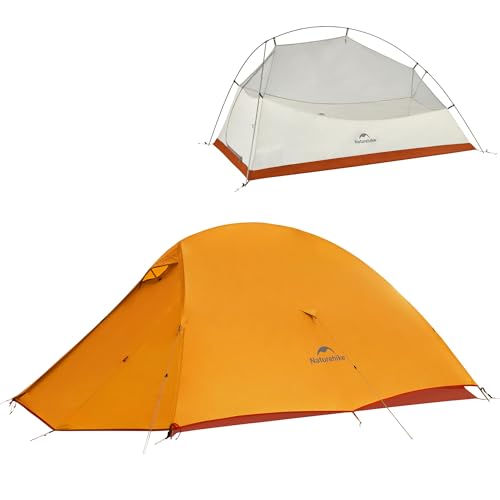
Naturehike Cloud Up Base 2 Person Tent
A double wall freestanding two person tent with a footprint included, at a sixth of the price of the flagship. Listed at 4.25 lb without the footprint, which is heavy by ultralight standards and light by any other.
Best for: Learning what you actually want in a shelter before spending $600 finding out.
Durston X-Mid 2 Pro
Trekking poles replace tent poles, so two items become one and the tent lands near 20 ounces in Dyneema. The offset pole geometry means the doors are actually usable, which most pole tents cannot claim.
Best for: Anyone already hiking with poles. If you do not use poles this is a bad trade, not a good one.

NEMO Hornet OSMO 2P
Semi-freestanding, so it goes up on a tent pad or a rock slab where a staked shelter will not. OSMO fabric stretches less when wet than the silnylon it replaced, which is the practical difference on a rainy multi-day.
Best for: Established campsites, alpine platforms, and anyone who does not want to think about pitch tension at midnight.

Big Agnes Copper Spur HV UL2
Two doors, two vestibules, near vertical walls and enough headroom to sit out a storm day without going mad. It is the heaviest tent here and the only one two adults can genuinely live in.
Best for: Couples, and shoulder season trips where you may spend real time inside the tent.
Weights are the manufacturer's listed figures. Prices and stock change constantly, so confirm on the retailer page. We earn commissions from Backcountry and from qualifying Amazon purchases. Cottage gear sold direct earns us nothing and is listed anyway.
What actually makes a tent ultralight?
An ultralight tent is a shelter that reaches a usable pitch with less material, either by using thinner fabric, by borrowing structure from something you already carry, or by giving up interior volume. There is no certifying body and no threshold anybody enforces. The working line for a two person shelter is around two pounds, or 907 g.
The three levers are visible in the table below. The Naturehike Cloud Up Base 2 carries its own poles, uses conventional fabric and lands at 4 lb 4 oz, which is 68 oz or 1,928 g. The NEMO Hornet OSMO 2P uses lighter fabric and a minimal pole set and lands at 38 oz or 1,077 g. The Durston X-Mid 2 Pro deletes the poles entirely and uses Dyneema, landing at 20 oz or 567 g. Each step costs money, and each step costs something else too: durability, interior volume, or the ability to pitch without stakes.
Ignore the phrase "minimum trail weight" on a box. Brands quote it differently, and it usually excludes stakes, guylines and the stuff sack you will actually carry. The figures on this page are the manufacturer's listed weights for the configuration named, which is the only comparison that is even close to apples to apples. Gram conversions here are straight arithmetic from those listed ounces at 28.35 g per ounce, not separate manufacturer figures. Weigh your own once it arrives, because listed weights run optimistic often enough to matter.
Trekking pole shelter or freestanding: which should you buy?
A trekking pole shelter uses the poles already in your hands as the tent poles. That is not a small saving. Tent poles for a two person shelter run six to twelve ounces, which is 170 to 340 g, and a pole shelter removes all of it while adding nothing, because you were carrying the poles anyway. It is the single largest free weight saving available in a backpacking kit.
The word "free" is doing real work in that sentence. If you do not hike with trekking poles, buying a pole shelter means buying and carrying poles to hold your tent up, which turns a weight saving into a weight penalty plus an expense. In that case a light freestanding or semi-freestanding tent is the better purchase. Our trekking pole tent versus freestanding tent comparison works through the arithmetic in both directions, and the trekking pole guide covers what to buy if the answer turns out to be poles.
The second consideration is the ground. A trekking pole shelter needs stakes to stand up, so it needs ground that takes stakes. Established campsites with wooden tent pads, alpine rock slabs, desert hardpan and heavily used sites on the long trails can all refuse a stake. A semi-freestanding tent like the Hornet OSMO stands with the pole structure alone and only needs stakes to pull the corners out, and a fully freestanding tent like the Copper Spur HV UL2 can be picked up and moved fully pitched. That flexibility is what the extra ounces buy.
Stakes deserve one line of their own, because they are the cheapest failure point in a shelter system. The pins packed with most tents bend in rocky soil and pull straight out of sand. Six proper Y-beam stakes weigh a couple of ounces and are the first upgrade worth making to any shelter, budget or Dyneema.
Single wall or double wall, and why is the tent wet inside?
A double wall tent has a mesh inner body and a separate waterproof fly. A single wall tent has one waterproof layer and nothing between it and you. The difference is not waterproofing, it is condensation management, and condensation is the thing that surprises people the first time they use a light shelter.
You exhale roughly a litre of water over a night. When that vapour meets a surface colder than the dew point it turns back into liquid, and on a clear cold night the coldest surface in the shelter is the underside of the fly. In a double wall tent that water forms on the fly, with a mesh inner keeping it off your quilt. In a single wall tent it forms directly above your face, and any brush against the wall transfers it to your insulation. Down that gets wet loses most of its warmth and takes a long time to recover in the field, which is why this matters more than it sounds.
None of that makes single wall shelters a bad choice. They are lighter, they pitch faster, and experienced users manage the problem with vents, site selection and a small cloth. It does mean a single wall Dyneema shelter is an intermediate purchase, not a first one. Pitch away from water, choose a spot with some airflow rather than the lowest hollow in the meadow, and open every vent even when it looks like a clear night, because clear still nights are the worst ones for condensation. Wind and cloud both suppress it.
How do these four shelters compare?
| Shelter | Price | Listed weight | Grams | Poles | Walls |
|---|---|---|---|---|---|
| Naturehike Cloud Up Base 2P | $101.15 | 4 lb 4 oz | 1,928 g | Included, freestanding | Double |
| Durston X-Mid 2 Pro | About $700 | 1 lb 4 oz | 567 g | Your trekking poles | Single, Dyneema |
| NEMO Hornet OSMO 2P | $479.95 | 2 lb 6 oz | 1,077 g | Included, semi-freestanding | Double |
| Big Agnes Copper Spur HV UL2 | $599.95 | 3 lb 2 oz | 1,418 g | Included, freestanding | Double |
Read the first and last rows together. The Copper Spur costs six times what the Naturehike costs and saves 18 oz, or 510 g, which is a little over a pound for roughly $500. The X-Mid saves 48 oz, or 1,361 g, against the Naturehike, and it is the only row where part of the saving comes from gear you already own. That is the shape of this category: the money buys grams, and the grams get more expensive the further down you go.
What does the next tier up actually buy you, in grams per dollar?
Here is the framing that makes shelter shopping rational. Take the cheapest usable option as the baseline, in this case the Naturehike Cloud Up Base 2 at $101.15 and 1,928 g, then ask how many grams each upgrade removes and what each of those grams costs. Anything above about 2 g per dollar is a strong buy in this category. Anything at or below 1 g per dollar is being bought for a reason other than weight.
| Upgrade from the budget tent | Extra cost | Grams saved | Grams per dollar | What else you get |
|---|---|---|---|---|
| To NEMO Hornet OSMO 2P | $378.80 | 851 g | 2.2 g | Semi-freestanding, wet-stable fabric |
| To Durston X-Mid 2 Pro | About $598.85 | 1,361 g | 2.3 g | Deletes tent poles, Dyneema |
| To Big Agnes Copper Spur HV UL2 | $498.80 | 510 g | 1.0 g | Two doors, two vestibules, sit-up height |
The table says something the marketing does not. The X-Mid and the Hornet are buying roughly the same weight per dollar by two completely different mechanisms, and the Copper Spur is buying less than half as much weight per dollar because you are not really paying for weight at all, you are paying for liveable volume. That is a legitimate purchase, it is just not an ultralight one. Put your own candidates through the base weight calculator to see where the saving lands in the total.
Each pick in detail
Naturehike Cloud Up Base 2: the honest starting point
At $101.15 and 4 lb 4 oz, the Cloud Up Base 2 is a double wall freestanding two person tent with a footprint included, for roughly a sixth of what the flagship shelters cost. It is heavy by ultralight standards and light by every other standard, and its real value is that it lets you find out what you want in a shelter before spending $600 discovering it. It is also available on Amazon, which most of the gear further down this page is not. The trade is fabric durability and pack volume, both of which are fine for a few trips a year.
NEMO Hornet OSMO 2P: the pick for most people
The Hornet OSMO 2P at $479.95 and 1,077 g is semi-freestanding, which is the practical difference that keeps it useful across the widest range of campsites. The OSMO fabric matters for a specific reason: it stretches less when wet than the silnylon it replaced, so a pitch you set in dry evening air does not sag onto your face by 2am after rain. On a multi-day trip in wet weather that is the difference between getting up to retension guylines and sleeping through. The Amazon listing is the fallback if Backcountry is out of your size.
Durston X-Mid 2 Pro: the lightest, with conditions attached
The X-Mid 2 Pro is sold direct by Durston Gear only, and that link earns us nothing. Its offset pole geometry is the reason it stands out among trekking pole shelters: the doors are genuinely usable rather than being a slit you crawl through, which most pole tents cannot claim. At 567 g it is under half the weight of the Hornet. Two conditions apply. You must already hike with poles, and you must accept single wall condensation management as part of the deal.
Big Agnes Copper Spur HV UL2: the one two adults can live in
The Copper Spur HV UL2 at $599.95 and 1,418 g is the heaviest shelter here and the only one where two adults can sit up, keep their gear inside and wait out a storm day without going mad. Two doors means neither person climbs over the other at 3am. If your trips are with a partner, or include shoulder season weather that pins people down, this weight is bought for a reason. It is also stocked on Amazon.
What goes wrong with an ultralight shelter in the field?
A pitch that loosens overnight. Silnylon absorbs water and stretches, and a fly that was drum tight at dusk can be resting on the inner by midnight, wicking condensation onto your quilt. The fix is a mid-evening retension, or fabric that does not do it.
Ground that will not take a stake. This ends a trekking pole shelter's night. Carry two or three extra stakes, learn to build a rock deadman anchor, and check whether the sites you use are wooden platforms before you buy a shelter that cannot stand without stakes.
A punctured or torn floor. Light floor fabric is not fragile, but it is unforgiving of a sharp stick you did not clear. Sweep the site with your foot before pitching. A few grams of repair tape covers this and weighs nothing.
Wind from a direction you did not plan for. Every light shelter has a strong axis and a weak one. Pitch the narrow end into the prevailing wind, use every guyout point when the forecast is uncertain, and remember that a well pitched budget tent survives a night that a badly pitched Dyneema shelter will not.
Who should not buy the expert pick
The other expert level trap is the Durston X-Mid 2 Pro at roughly $700. It is the lightest and the most expensive shelter here, and it is the wrong purchase for three specific people: anyone who does not already hike with trekking poles, anyone whose regular campsites are wooden platforms or bare rock, and anyone buying their first shelter. Dyneema is superb material and an unforgiving thing to learn pitch tension on. Learn on something cheaper, then upgrade knowing exactly what you want.
Why the shelter is the last thing you should cut
Weight savings elsewhere in a kit are mostly comfort trades. A lighter pot means slower boils. A thinner pad means a worse night. Cutting your shelter below what the conditions require is a different category of decision, because a shelter is the thing standing between you and a night of wind driven rain, and wet plus wind is how hypothermia actually happens in three season conditions, well above freezing.
Say it plainly: the shelter is the last thing to cut. Going ultralight must never mean going unprepared. Cut a stove before you cut a shelter, cut spare clothing before you cut a shelter, and cut the fourth pair of socks long before you consider a tarp for a trip where you may be pinned down for a day. If you want the weight down, take it out of the other two of the big three first, or out of the small items that quietly add up.
The corollary is that a shelter you understand beats a lighter one you do not. Pitch any new tent in a yard or a park before it goes on a trip. Learn where the guylines attach, how tight the fly needs to be, and how it behaves when you have to set it up in rain with cold hands. That practice is free and it is worth more than 300 g of fabric.
Related reading
- Trekking pole tent vs freestanding tent: which system actually saves you weight
- Tent vs tarp vs hammock: choosing a shelter type before choosing a model
- Tent weight comparison chart: listed weights side by side
- The big three explained: shelter, pack and sleep system
- Base weight calculator: see what a shelter swap does to your total
- Best trekking poles: required reading before a pole shelter
Frequently asked questions
What is the best ultralight tent for most backpackers?
The NEMO Hornet OSMO 2P at $479.95 and 2 lb 6 oz, which is 38 oz or 1,077 g, suits most people because it is semi-freestanding and pitches on a wooden tent pad or a rock slab where a fully staked shelter will not stand. If you already hike with trekking poles, the Durston X-Mid 2 Pro is far lighter at 1 lb 4 oz because the poles you are already carrying replace the tent poles entirely.
How light does a tent have to be to count as ultralight?
There is no certifying body, but the working line for a two person shelter is roughly two pounds, and under a pound and a half is genuinely light. For context, the Durston X-Mid 2 Pro lists at 1 lb 4 oz or 567 g, the NEMO Hornet OSMO 2P at 2 lb 6 oz or 1,077 g and the Naturehike Cloud Up Base at 4 lb 4 oz or 1,928 g. Your total base weight matters more than whether one item earns a label.
Are trekking pole tents worth it?
Only if you already hike with poles. A trekking pole shelter deletes the tent poles from your pack, so two items become one and you save six to twelve ounces for free. If you do not use poles, you now have to carry poles solely to hold the tent up, which is a worse trade than simply buying a lighter freestanding tent. The answer depends entirely on what is already in your hands.
Why is my ultralight tent wet inside in the morning?
That is condensation, not a leak. You exhale close to a litre of water overnight, and any of it that reaches a surface colder than the dew point turns back into liquid. Single wall shelters put that cold surface directly above you. Double wall tents put a mesh inner between you and the wet fly. Pitch with both vents open, avoid low ground near water, and expect a damp fly most clear cold nights.
Is a footprint necessary under an ultralight tent?
Usually not, and it is one of the easier places to save six to ten ounces, which is 170 to 285 g. Modern floor fabrics handle grass, duff and sand without help. If you camp on sharp granite, gravel bars or desert crust, a cut sheet of polycryo weighing an ounce or two does the same job as the branded footprint at a fraction of the weight and price.
Should I buy a one person or a two person ultralight tent?
Most solo hikers should buy a two person shelter. The weight penalty on modern designs is often under eight ounces, and the extra floor area is where your pack, your wet rain gear and your shoes go on a storm day instead of onto your quilt. One person tents make sense when pitch sites are genuinely narrow, or when you are splitting a shelter with nobody and counting every gram.
How we choose: we compare published manufacturer specifications, listed weights, and verified owner reviews across retailers. We do not test gear in person, and every weight quoted here is the manufacturer's figure unless we say otherwise, so weigh your own kit before you trust a total. Going lighter also means carrying less margin, so treat insulation, navigation, water treatment and an emergency plan as fixed costs rather than places to save grams.