Best Trekking Poles for Ultralight Backpacking
The Cascade Mountain Tech Carbon Fiber Trekking Poles ($64.99, 10.4 oz or 295 g per pair) are the best trekking poles for most ultralight backpackers, because they weigh exactly the same as poles costing $132.18 more and they adjust to pitch a trekking pole shelter. Poles carried in your hands are worn weight, not base weight.
The Cascade Mountain Tech Carbon Fiber Trekking Poles are the best pair for most ultralight backpackers at $64.99 and 10.4 oz (295 g) per pair, which is the identical listed weight to the $197.17 Black Diamond Distance Carbon Z above them. That is the whole argument for buying the cheap ones: in this category the extra $132.18 buys a folding mechanism and a warranty, and it buys zero grams.
Poles are also the one purchase that changes the arithmetic of your entire gear list, because a trekking pole shelter deletes its own poles and uses these instead. Below are three pairs at genuinely different price points, then the two things that actually decide whether a pole lasts a season or a decade: the lock mechanism and the material.
Best trekking poles by experience level
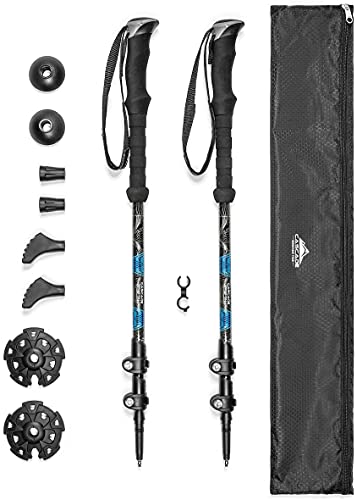
Cascade Mountain Tech Carbon Fiber Trekking Poles
Carbon poles at an aluminium price, and the pair most commonly seen holding up a trekking pole tent. Flip locks are the failure point, so carry a small screwdriver or check them at every road crossing.
Best for: Nearly everyone, and mandatory if your shelter needs poles to stand up.
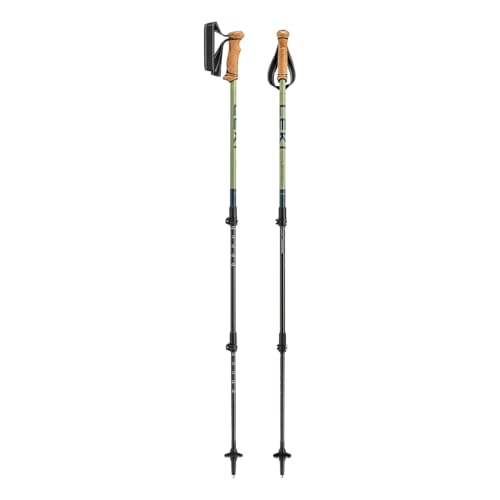
LEKI Legacy Lite Trekking Poles
Aluminium rather than carbon, which means they bend under a sideways load instead of snapping, and LEKI sells replacement parts for them years later. Heavier than the carbon options by a few ounces and far less likely to end a trip.
Best for: Rocky terrain, scree, and anyone who has already broken a carbon pole.

Black Diamond Distance Carbon Z Trekking Poles
Z-folding, fixed length, no adjustment mechanism to fail. Fixed length means you must buy the right size the first time, and it means they cannot be shortened to pitch a shelter that wants a specific height.
Best for: Runners and fast packers who want the poles stowed on their pack half the day.
Weights are the manufacturer's listed figures. Prices and stock change constantly, so confirm on the retailer page. We earn commissions from Backcountry and from qualifying Amazon purchases. Cottage gear sold direct earns us nothing and is listed anyway.
Are trekking poles base weight or worn weight?
Base weight is the contents of your pack minus food, water and fuel. Poles in your hands are not in your pack, so they are worn weight, in the same bucket as your shoes, your shirt and the phone in your hip belt pocket. That is not a loophole, it is the standard definition, and it is why two hikers can post identical gear lists with a 295 g gap between the totals.
The honest version is that worn weight still costs you energy, it just costs less than weight riding high in a pack. Where the distinction becomes dishonest is when poles get strapped to the outside of the pack for half the day. If you stow your poles on climbs, count them in the pack. Our base weight calculator keeps worn items in a separate column for exactly this reason, so the number you quote is the number you carry.
For scale against the rest of a kit: 295 g of poles is about 1.8 percent of a 10 lb (4,536 g) ultralight base weight, and it is less than the 397 g of a Therm-a-Rest Z Lite Sol foam pad. Poles are not where your weight problem lives, which is why arguing about 295 g against 482 g is usually the wrong argument to be having.
If your shelter needs poles, are they optional?
No. This is the single most important thing on the page. A trekking pole shelter like the Durston X-Mid 2 Pro does not ship with poles, so the 1 lb 4 oz (567 g) shelter weight you see quoted assumes you were already carrying a pair. Buy that shelter without poles and you have not saved weight, you have bought a tent that does not stand up.
Run it the other way and the trade looks excellent. The poles replace the dedicated tent poles you would otherwise carry, so two items collapse into one and the pole weight is already paid for by the walking. Compare that with the freestanding route: the NEMO Hornet OSMO 2P lands at 2 lb 6 oz (1,077 g) with its own poles included, against 567 g for the X-Mid plus 295 g of Cascade poles you were carrying anyway. That is the real saving, and it is the reason pole shelters dominate long trail gear lists.
If you genuinely do not want to hike with poles, a pole shelter is a bad trade for you specifically, and the comparison in trekking pole tent versus freestanding tent lays out why. The failure case is worth stating plainly: a hiker who buys a pole shelter, decides on day three that poles annoy them, and now cannot pitch their tent without finding two sticks.
Flip locks or twist locks, and what actually breaks
Almost every adjustable pole failure is a lock failure, not a shaft failure. A twist lock uses an internal plastic expander that grips the inside of the upper section when you rotate it. Grit, wear and a hard side load all reduce that grip, and once it starts slipping it tends to slip at the worst moment, part way down a loaded descent with your weight on it. Field repair is unreliable because the failed part is inside the pole.
What that failure looks like in the field: you plant the pole, it takes weight for half a second, then the lower section telescopes six inches into the upper and you drop with it. On a scree traverse that is a fall, not an inconvenience. The second version is slower and more insidious, where the pole creeps a centimetre at a time until you notice at lunch that one pole is noticeably shorter than the other and your shoulder has been compensating all morning.
A flip lock clamps externally with a visible screw. When it slips, you turn the screw a quarter turn and carry on, which is a thirty second fix rather than a trip-ending one. Carry a small screwdriver or a coin that fits, and check the tension at road crossings and resupply stops rather than waiting for a slip. On the Cascade Mountain Tech poles this single habit is the difference between a bargain and a disappointment, and it is the one maintenance task the category has.
Fixed length Z-folding poles sidestep the argument entirely by having no adjustment mechanism to fail. The internal shock cord is the only moving part, and when it stretches after a few seasons the poles get sloppy to assemble rather than dangerous to use. That is a genuine reliability advantage and it comes with a genuine cost, covered further down.
Carbon snaps, aluminium bends
Carbon fibre is stiffer and lighter for a given strength along its axis, which is why it wins on spec sheets. Its weakness is a sideways impact, and the classic one is a pole tip wedged in a rock crack while your body keeps moving. Carbon does not complain first. It goes from fine to two pieces, and there is no partial-credit outcome.
Aluminium bends instead. A bent pole is ugly, it may not collapse properly, and it will still hold up your shelter tonight. That is why the LEKI Legacy Lite sits in the middle tier at about 17 oz (482 g) per pair despite being the heaviest option here: on scree, in talus, and anywhere your pole tips disappear between rocks, the extra 187 g buys you a pole that fails gracefully. LEKI also sells replacement parts years later, which quietly matters more than the weight difference over a decade.
The decision rule that actually works: if a broken pole means an uncomfortable walk out, buy carbon. If a broken pole means no shelter tonight, buy aluminium or carry a repair sleeve. A short section of aluminium tubing that slides over a snapped carbon shaft weighs almost nothing and turns a trip-ending failure into an ugly but functional pole, and it is the single most underrated item in this category.
| Poles | Price | Per pair (oz) | Per pair (g) | Material | Adjustment |
|---|---|---|---|---|---|
| Cascade Mountain Tech Carbon Fiber | $64.99 | 10.4 oz | 295 g | Carbon | Telescoping, flip lock |
| LEKI Legacy Lite | See retailer | About 17 oz | About 482 g | Aluminium | Telescoping, adjustable |
| Black Diamond Distance Carbon Z | $197.17 | 10.4 oz | 295 g | Carbon | Z-folding, fixed length |
What does the next tier up actually buy you?
This is the question worth asking of every upgrade on this site, and the honest way to ask it is grams saved per dollar spent. Trekking poles are the category where that number is most brutal, because the expensive pair and the cheap pair weigh exactly the same.
| Upgrade | Extra cost | Grams saved | Grams per dollar | What you actually buy |
|---|---|---|---|---|
| LEKI Legacy Lite to Cascade carbon | See retailer | 187 g | Not priced | Carbon stiffness, at the cost of graceful failure |
| Cascade carbon to Black Diamond Distance Carbon Z | $132.18 | 0 g | 0.00 | Z-folding packability, no lock to fail, a warranty |
| For comparison, a pack upgrade | $65.97 | 510 g | 7.73 g per dollar | Naturehike Rock 60L to Granite Gear Crown3 |
Read the middle row again. $132.18 for zero grams. There are perfectly good reasons to spend it, and lighter poles is not one of them. Now read the footer row: roughly half that money moves you from the 1,503 g Naturehike Rock 60L to the 992 g Granite Gear Crown3, which is 510 g gone at 7.73 g per dollar. The lesson generalises: spend money where the grams are, and in this category the grams are not there.
Who should not buy the expert pick
Their real audience is fast packers and runners who stow the poles on the pack for half the day and want the smallest possible folded package, plus anyone who has already destroyed two sets of locks and wants a pole with none. If your poles stay in your hands and hold up your tent at night, the $64.99 adjustable pair is the better tool at the identical listed weight of 295 g.
Tips, baskets and the parts that wear out
The carbide tip is a consumable. It grinds down over a few hundred miles of rock and pavement, and a rounded tip skates on wet granite exactly when you need it not to. Most poles take replacement tips, and checking whether yours do is worth thirty seconds before you buy.
Baskets matter more than they look. The small trekking baskets stop a pole plunging into soft ground and mud, and they snag on brush and roots often enough that plenty of hikers remove them on dry trail. Wide snow baskets are a separate item and they are not optional in snow: without them a pole disappears to the grip on every plant, which is exhausting and useless for balance. If you are heading into winter conditions, budget for them.
The rubber tip protectors are for pavement and for protecting your pack fabric in transit. On trail they come off, because rubber on rock is worse than carbide on rock and because you will lose them anyway. Straps are the last wear item, and a strap that has gone stiff and gritty is the reason your hands are sore, not the pole.
What to check before your first trip with poles
- Set the length on flat ground first. Elbows at roughly 90 degrees with the tips down puts most hikers between 110 and 130 cm.
- Use the straps properly. Hand up through the loop, then down onto the grip, so the strap carries the load and your fingers just steer. Gripping the pole hard all day is how you get sore forearms.
- Pull the rubber tip protectors off on trail. Carbide tips grip rock and ice; the rubber caps are for pavement.
- Check flip lock tension at every resupply. This is the maintenance item, and it takes thirty seconds.
- Loosen the sections at home. Storing poles fully collapsed and wet is how locks seize and how corrosion starts inside aluminium shafts.
- Carry a repair sleeve on carbon. A few grams of tubing turns a snapped pole into a working one, and into a shelter that still pitches.
- Do not skip poles to hit a weight target. Going lighter is not the same as going unprepared, and balance on a stream crossing is not a luxury item.
Related reading
- Trekking pole tent versus freestanding tent: whether the shelter saving is real for your kit
- Base weight calculator: keeps worn weight in its own column
- Best ultralight tent: the shelters that use these poles
- How to cut base weight: where the ounces actually are
- Tent weight comparison: pole shelters against freestanding, by weight
- All gear reviews
Frequently asked questions
Do trekking poles count toward base weight?
No, as long as they are in your hands. Base weight is the contents of your pack minus food, water and fuel, and anything you carry on your body at the trailhead is worn weight instead. A pair of poles at 10.4 oz, or 295 g, is worn weight while you walk and pack weight the moment you strap them to the outside of the pack, which is why gear list totals disagree so often.
Are carbon or aluminium trekking poles better?
Carbon is lighter and stiffer, aluminium is more survivable. Carbon fails suddenly and completely when it is loaded sideways, usually wedged between two rocks, while aluminium bends and keeps working badly. If your shelter needs a pole to stand up, a bent aluminium pole is still a tent pole and a snapped carbon pole is not. Choose by terrain, not by the weight on the spec sheet.
Flip locks or twist locks, which is more reliable?
Flip locks, by a wide margin. A twist lock relies on an internal expander that slips once it wears or gets grit in it, and it usually slips under load part way down a descent. A flip lock has a visible tension screw you can adjust in seconds with a small screwdriver or a coin. Check flip lock tension at every road crossing and the failure mostly stops happening.
Can I use fixed length poles with a trekking pole tent?
Sometimes, but check the shelter spec before you buy. Many pole tents want a specific pitch height, often somewhere between 45 and 50 inches at the peak, and a fixed length Z-pole cannot be adjusted to meet it. Adjustable poles solve this outright. If you already own fixed length poles, confirm the shelter pitches at that exact height rather than assuming a tensioned guyline will absorb the difference.
What length trekking poles do I need?
The standard starting point is elbows bent at about 90 degrees with the tip on flat ground, which puts most hikers between 110 and 130 cm. Shorten them a few centimetres for sustained climbs and lengthen them for sustained descents if the poles adjust. Fixed length poles remove that option, so buy the length that matches your flat ground position rather than a compromise.
Do trekking poles actually reduce knee load?
Poles move a share of the descending load into your arms and shoulders, and most hikers notice it first on long downhills with a loaded pack. They also buy back balance on stream crossings, loose scree and snow, which is the part people underrate. The trade is that your hands are occupied and your arms get tired, so the benefit is real but it is not free.
How we choose: we compare published manufacturer specifications, listed weights, and verified owner reviews across retailers. We do not test gear in person, and every weight quoted here is the manufacturer's figure unless we say otherwise, so weigh your own kit before you trust a total. Going lighter also means carrying less margin, so treat insulation, navigation, water treatment and an emergency plan as fixed costs rather than places to save grams.