Down vs Synthetic Insulation: Which to Buy
Down is roughly two to three times warmer per ounce than synthetic insulation and compresses far smaller, so a 20 degree bag needs about 15.5 oz of 850 fill down against about 24 oz of 550 fill and considerably more synthetic. Choose down for almost all three season backpacking. Choose synthetic when the insulation will get wet and stay wet, because soaked down loses nearly all its warmth and takes days to dry.
For almost every backpacker, in almost every condition, down wins. It is roughly two to three times warmer per ounce than synthetic insulation, it packs to a fraction of the volume, and it lasts decades rather than seasons. The exception is narrow and it is absolute: when the insulation is going to get soaked and stay soaked, down fails and synthetic does not. That is the entire comparison. Everything below is the detail you need to work out which side of that line your trips fall on.
What is fill power and why does it decide the weight?
Fill power is the volume in cubic inches that one ounce of down lofts to under a standard weight in a laboratory cylinder. 850 fill down means one ounce of it expands to fill 850 cubic inches. That is the whole definition, and it is a measure of quality per ounce rather than of total warmth.
The reason it decides everything is that warmth comes from trapped still air, not from feathers. A sleeping bag rated to a given temperature needs a certain total volume of lofted insulation around you, and that number does not care what fill power you use to reach it. So the arithmetic is simple division. If a 20 degree bag needs roughly 13,200 cubic inches of loft, then 850 fill down gets you there with about 15.5 ounces, while 550 fill down needs about 24 ounces of the same material to do the identical job.
The penalty compounds, because more fill needs more shell fabric and more baffle material to contain it, and it makes the bag physically larger. That is why the difference between a budget down bag and a premium one is far larger than the fill weight alone suggests, and why packed volume separates them even more sharply than weight does.
How much down does a 20 degree bag actually need?
The table below runs that division across the fill powers you will see on product pages, holding the target loft constant at a comparable 20 degree rating. Fill weights are calculated from the fill power definition. Finished weights and prices are the ranges published for real bags at each grade and are anchored at both ends by products listed further down this page.
| Fill power | Down needed | Finished bag | Packed volume | Typical price | Where you see it |
|---|---|---|---|---|---|
| 550 | 24.0 oz | 40 to 44 oz | 13 to 16 L | $150 to $200 | Budget down bags, big box brands |
| 650 | 20.3 oz | 35 to 38 oz | 11 to 13 L | $200 to $260 | Mainstream three season bags |
| 700 | 18.9 oz | 32 to 35 oz | 10 to 12 L | $250 to $330 | Entry cottage quilts |
| 800 | 16.5 oz | 29 to 32 oz | 8 to 10 L | $330 to $450 | The ultralight default |
| 850 | 15.5 oz | 27 to 30 oz | 7 to 9 L | $450 to $680 | Premium bags and quilts |
| 900 and up | 14.7 oz | 25 to 28 oz | 6 to 8 L | $600 to $900 | Specialist alpine and record chasing |
| 550 to 900 spread | 9.3 oz | About 15 oz | About 8 L | Roughly 4x | Same warmth, same night |
Read the last row carefully, because it is the honest summary of what fill power buys. Going from 550 to 900 fill saves about 15 ounces on a finished bag and roughly halves the packed volume, and it costs about four times as much. Under a pound of savings for several hundred dollars is a real trade, not an obvious one. It is a better trade than most other ounce hunting, which is why the sleep system sits inside the Big Three, but it is not free.
You can see both ends of that table in real products. The Kelty Cosmic 20 uses 550 fill down and lands at 2 lb 10 oz, which is 42 ounces, for $189.95. The Western Mountaineering UltraLite 20 uses 850 plus fill and lands at 1 lb 13 oz, which is 29 ounces, for $680. Same nominal rating, 13 ounces and roughly $490 apart, and almost all of that difference is fill power.
Every temperature rating on this page is a survival rating, not a comfort rating. EN 13537 and ISO 23537 limit figures describe roughly the temperature at which an average adult male survives the night curled up. The comfort rating typically sits 10 to 15 degrees Fahrenheit warmer, so plan a 20 degree bag for nights near 30 to 35 degrees. The extreme rating is survival with injury and must never be used for planning. See the temperature rating reference for what each published figure means.
How do down and synthetic compare head to head?
The table below sets the two insulation types against each other on the properties that decide a purchase, at a comparable three season warmth level.
| Property | Down, 800 fill | Synthetic | Winner |
|---|---|---|---|
| Warmth per ounce, dry | 1.0x reference | 0.35 to 0.5x | Down, by 2 to 3 times |
| 20 degree bag weight | 29 to 32 oz | 48 to 64 oz | Down, by 1 to 2 lb |
| Packed volume, 20 degree | 8 to 10 L | 16 to 22 L | Down, by half |
| Warmth retained soaked | Near 0 percent | 50 to 70 percent | Synthetic, decisively |
| Dry time, soaked, field conditions | 1 to 3 days | 2 to 6 hours | Synthetic, decisively |
| Useful lifespan with care | 15 to 25 years | 3 to 6 years | Down, by 4 times |
| Loft lost per year of normal use | Very little | 10 to 20 percent | Down |
| Price, 20 degree bag | $330 to $680 | $120 to $250 | Synthetic |
| Cost per year over its life | $20 to $35 | $30 to $60 | Down, once amortised |
| Washing | Specialist wash, hours of tumble | Normal gentle cycle | Synthetic |
| Storage requirement | Uncompressed, always | Uncompressed, forgiving | Synthetic |
| Ethical traceability | RDS certified supply chains | Petrochemical, no welfare issue | Different concerns |
The two rows that decide most purchases are the fourth and the fifth. Down retains close to nothing when it is genuinely soaked, because wet clusters clump and lose all loft, and loft is the entire mechanism. Synthetic fibres are stiff and continuous, so they hold their structure with water in them and keep a usable fraction of their warmth. On dry time, a soaked down bag in a damp tent may not recover for days, while a synthetic one is often usable again by evening.
A soaked down bag is a hypothermia risk, not an inconvenience. If your only insulation collapses and you are wet, cold and stopped for the night, the situation escalates quickly and it does not require winter to do so. Wet clothing plus wind plus a hiker who has stopped moving causes hypothermia at 45 degrees Fahrenheit. Down goes in a waterproof liner or a dry bag inside the pack, every trip, without exception, and it is the one item in the pack that must stay dry.
Does hydrophobic down fix any of that?
Partly, and less than the marketing implies. Hydrophobic down is ordinary down whose clusters have been treated with a durable water repellent finish at the fibre level. The measurable effects are real: treated down absorbs water more slowly, holds less of it, and dries somewhat faster than untreated down.
What that buys you in the field is time. Against tent condensation dripping on the footbox, five days of humid air, a light splash across a stream or a bag that never quite airs out, treated down keeps working where untreated down would be noticeably flatter by night four. That is a genuine benefit and it is worth having.
What it does not buy you is immunity. Submerge treated down, or leave it out in sustained rain, and it wets out and collapses like any other down. The treatment also degrades with repeated washing, so a bag that shipped hydrophobic is less hydrophobic after its fifth wash. The Rab Electron Pro uses 800 fill hydrophobic down in box wall construction and is a genuinely warm jacket, and the correct way to use it is still underneath a shell rather than instead of one. Treat hydrophobic down as a longer grace period, never as waterproofing.
When does synthetic win outright?
When wet is not a risk to manage but a condition to plan around. Three cases qualify.
Sustained multi day rain. A Pacific Northwest autumn, a Scottish crossing, a week on the Olympic coast. In sustained rain nothing in the pack stays perfectly dry over enough days, humidity never drops enough for anything to dry out, and there is no sunny afternoon in which to recover. Synthetic degrades gracefully across that week. Down degrades cumulatively, getting a little flatter each night with no chance to recover, which is a worse pattern than a single soaking.
Water based trips. Sea kayaking, canoe trips and packrafting all carry a non trivial chance of full immersion for gear, not just for people. A capsize that soaks a down bag ends the trip. The same capsize with synthetic insulation is a bad afternoon.
Winter tent condensation. This one surprises people. In a cold tent, moisture from your breath and body migrates outward through the bag and freezes near the outer shell. Each day it thaws slightly and refreezes, and over a week of winter camping the fill absorbs a meaningful amount of water with no rain involved at all. Expedition sleep systems often use a synthetic overbag over a down bag for exactly this reason, putting the condensation zone in the layer that tolerates it.
Note that the site does not currently list a synthetic sleeping bag among its picks, because in three season conditions the down options are better in every dimension that is not the wet case. If your trips sit squarely in the wet case, shop synthetic bags specifically and expect to carry 1 to 2 pounds more for the same warmth. That is the price of the insurance and it is a fair one.
What do the real down options look like?
Down bags and quilts across the fill power range

Kelty Cosmic 20 Down Mummy Sleeping Bag, Regular
Real 550 fill down at a synthetic price. The lower fill power means more of it, so it packs bigger and weighs more than a premium bag at the same rating, but it keeps you warm and it costs a fifth as much.
Best for: A first three season bag, and car-to-trail weekends where a pound either way is not the deciding factor.
Enlightened Equipment Revelation 20
A quilt deletes the insulation you were compressing under you anyway, plus the hood, plus the zipper. Built to order in your length, width, fill power and temperature rating, which is why cottage quilts fit better than off the shelf bags.
Best for: Back and side sleepers who already own a warm pad. Restless sleepers should expect a few nights learning to manage drafts.

Sea to Summit Spark Pro 30 Down Sleeping Bag
Ultra high fill power down in a minimal shell, which is how a full mummy bag gets under 20 ounces. A 30 degree rating is a summer and shoulder season rating, not a three season one for most people.
Best for: Warm sleepers and summer alpine trips where every ounce is already accounted for.

Western Mountaineering UltraLite 20 Degree
The bag people keep for twenty years. 850+ fill down, continuous baffles, and a temperature rating that people who sleep cold report as honest, which is rare.
Best for: Cold sleepers, and anyone buying one bag for the next two decades rather than the next two seasons.
Weights are the manufacturer's listed figures. Prices and stock change constantly, so confirm on the retailer page. We earn commissions from Backcountry and from qualifying Amazon purchases. Cottage gear sold direct earns us nothing and is listed anyway.
The spread in that block is the fill power table made concrete. The Sea to Summit Spark Pro 30 reaches 1 lb 3 oz through very high fill power down in a minimal shell, which is exactly the top row of the table in product form, and its 30 degree rating means comfortable closer to 40 to 45 degrees for most sleepers. The Kelty Cosmic 20 at the other end is real down at a synthetic price, and the extra weight it carries is the direct cost of 550 fill.
Quilts: the same down, less of it
Hammock Gear Economy Burrow
The usual entry point into cottage quilts: lower fill power down, fewer options, roughly half the price of the premium builds. You carry a few extra ounces for the same warmth, which is the correct trade at this price.
Best for: A first quilt, and anyone who wants to find out whether they sleep well without a zip before spending $400.
Enlightened Equipment Revelation 20
The quilt that made the category mainstream. The footbox zips fully open, so it works as a quilt in summer and closes down like a bag when the temperature drops, and it is built to your length, width, fill power and rating.
Best for: Back and side sleepers who already own a warm pad and want one quilt for most of the year.
Katabatic Gear Palisade 30
The pad attachment system is the reason people pay the premium: a cord and clip arrangement that seals the quilt to the pad edge rather than relying on you staying still. Drafts are the only real failure mode of a quilt and this is the best answer to them.
Best for: Restless sleepers, and anyone who has tried a quilt, woken up cold at 3am, and concluded quilts do not work.
Nunatak Arc UL
One of the original quilt makers, still building each one to order with a long list of fabric and fill choices. Lead times are long and the fit is as close to bespoke as this category gets.
Best for: People who already know exactly what they want and cannot find it off a shelf.
Weights are the manufacturer's listed figures. Prices and stock change constantly, so confirm on the retailer page. We earn commissions from Backcountry and from qualifying Amazon purchases. Cottage gear sold direct earns us nothing and is listed anyway.
Quilts change the arithmetic again, because the down underneath a sleeping bag is crushed flat by your body and does almost nothing. The Enlightened Equipment Revelation 20 lands at 1 lb 5 oz by deleting that fill along with the hood and the zipper, and the Hammock Gear Economy Burrow reaches a lower price by using lower fill power down, which is precisely the trade described in the table above. The full argument is in the quilt versus sleeping bag comparison.
Insulation and shells for the clothing system
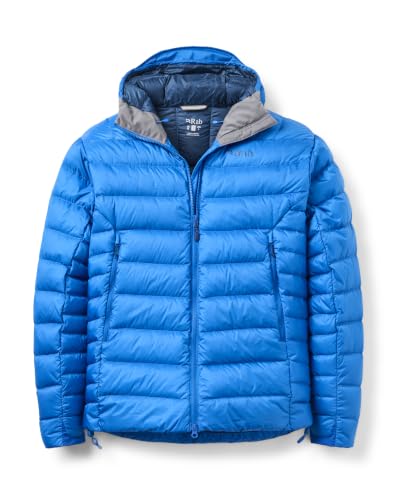
Rab Electron Pro 800 Fill Down Hooded Jacket
800 fill hydrophobic down in a box wall construction, which is a genuinely warm jacket rather than a light puffy. Down loses most of its value soaked, so this needs a rain shell over it, not instead of it.
Best for: Shoulder season and alpine camps, and anyone who gets cold the moment they stop moving.

Outdoor Research Helium Rain Jacket
Under seven ounces with a hood and pit-free minimal construction, and durable enough to last seasons rather than months. No jacket at this weight breathes well, so expect to be damp from one side or the other.
Best for: Three season use where rain is a possibility rather than a certainty.

Frogg Toggs Ultra-Lite2 Rain Suit
A jacket and pants for the price of a takeaway meal, and lighter than most single rain jackets. The fabric tears on brush, so treat it as a consumable rather than a purchase.
Best for: Thru-hikers who replace rain gear every few hundred miles anyway.
Weights are the manufacturer's listed figures. Prices and stock change constantly, so confirm on the retailer page. We earn commissions from Backcountry and from qualifying Amazon purchases. Cottage gear sold direct earns us nothing and is listed anyway.
The same physics governs your jacket. The Rab Electron Pro is 800 fill down and needs a waterproof layer over it, whether that is the Outdoor Research Helium at 6.3 ounces or the cheaper Frogg Toggs Ultra-Lite2 set. A down jacket worn as an outer layer in rain is a down jacket you have decided to destroy. The layering system guide covers where the insulating layer sits and when it should come out of the pack at all.
How do you make down last twenty years?
Three habits, and they are the difference between a bag that outlives the decade and one that goes flat in four seasons.
Store it uncompressed. This is the big one. Down left crushed in a stuff sack for months takes a permanent set and never fully recovers. Keep it in the large cotton or mesh sack it shipped with, or hang it. More expensive bags have been ruined by a closet than by any weather.
Wash it rarely, and correctly. Use a down specific wash rather than detergent, which strips the natural oils that let clusters loft. Front loading machine, gentle cycle, extra rinses, then a very long low heat tumble dry with a few clean tennis balls to break up the clumps. It takes hours and stopping early leaves damp clumps inside the baffles. Between washes, a liner keeps body oils off the fill and extends the interval by years.
Air it after every trip. A bag that goes into storage carrying a few nights of body moisture is a bag that will smell and lose loft. Turn it inside out and give it a few hours somewhere dry before it goes away.
On sourcing, look for the Responsible Down Standard or the Global Traceable Down Standard on the product page. Both are third party certifications that trace down through the supply chain and prohibit live plucking and force feeding. Most major brands now certify, and it is one of the few ethical claims in outdoor gear with a real audit trail behind it.
So which should you buy?
Buy down unless your trips are genuinely and repeatedly wet. For three season backpacking in most of the country, down at 800 or 850 fill in a bag or quilt kept inside a dry bag is the right answer, and the weight and volume it saves compound through the whole kit, because a smaller sleep system permits a smaller pack. Start with the sleeping bag roundup or the quilt roundup at the rating your conditions call for.
Buy synthetic if you paddle, if you hike a coast in a rainy season, if your gear gets handled by other people, or if you know from experience that your bag ends up damp. Accept 1 to 2 pounds and shop for the best synthetic you can find rather than the lightest.
Whichever you choose, going ultralight must not mean going unprepared. You are responsible for carrying insulation adequate for the conditions you will actually meet, and for keeping it dry enough to work when you stop moving. Shelter, insulation, rain gear, navigation, water treatment and a way to call for help are fixed costs. Find the grams somewhere they are not load bearing.
Frequently asked questions
What does fill power actually measure?
Fill power is the number of cubic inches that one ounce of down lofts to under a standard weight in a lab cylinder. 850 fill down means one ounce expands to 850 cubic inches. Since warmth comes from trapped air rather than from feathers, higher fill power means fewer ounces of down are needed for the same loft. It is a measure of quality per ounce, not of total warmth.
Is down really warmer than synthetic insulation?
Per ounce, yes, by roughly two to three times at typical fill powers, and the gap grows as fill power rises. Down also compresses far smaller for the same warmth, which matters as much as weight once you are choosing a pack volume. Synthetic insulation closes none of that gap when dry. It closes all of it and more when the insulation is soaked.
Does hydrophobic down solve the wet problem?
No, it delays it. A durable water repellent treatment applied to the down clusters slows how fast moisture penetrates and speeds drying somewhat, which is genuinely useful against tent condensation and light dampness over a few days. It does not make down work when soaked, and the treatment wears off over repeated washes. Treat hydrophobic down as a longer grace period, never as waterproofing.
When is synthetic insulation the better choice?
Whenever staying dry is not realistic. Multi day rain in the Pacific Northwest, sea kayaking and packrafting, guided trips where gear gets handled by other people, and winter tents where condensation freezes and then melts into your bag. Synthetic keeps a usable fraction of its warmth wet and dries in hours rather than days, which is the entire argument and it is a strong one.
How should I store a down sleeping bag between trips?
Uncompressed, dry, and loose. Store it in the large cotton or mesh sack it shipped with, or hang it in a closet. Down left compressed in a stuff sack for months loses loft permanently, which is the most common way people destroy an expensive bag without ever getting it wet. Air it out after every trip before it goes away, because body moisture accumulates in the fill.
What is the Responsible Down Standard?
The Responsible Down Standard is a third party certification that traces down through the supply chain and prohibits live plucking and force feeding. Most major brands now certify to it or to an equivalent scheme such as the Global Traceable Down Standard. It is worth checking on the product page, because it is one of the few ethical claims in outdoor gear that carries an audit trail behind it.
How we choose: we compare published manufacturer specifications, listed weights, and verified owner reviews across retailers. We do not test gear in person, and every weight quoted here is the manufacturer's figure unless we say otherwise, so weigh your own kit before you trust a total. Going lighter also means carrying less margin, so treat insulation, navigation, water treatment and an emergency plan as fixed costs rather than places to save grams.