Nitecore NB10000 Gen II Review: The Power Bank Hikers Buy
Ten thousand milliamp hours in a body Nitecore state is 40 percent lighter than typical power banks and thinner than a phone, with dual USB and USB-C quick charge ports, IPX5 water resistance and a low current mode for small devices. Buy it as the default backpacking power bank. Just do not plan around the label: the rated capacity is cell capacity, and conversion losses mean the energy that actually reaches your phone is meaningfully less.
Ten thousand milliamp hours in a body thinner than a phone, and the delivered capacity nobody quotes.
Nitecore NB10000 Gen II Ultra-Slim Power Bank, 10000 mAh, QC USB and USB-C
Under $100
A slim 10000 mAh power bank with dual quick-charge ports, a low current mode, IPX5 water resistance and a cable bundle.
Check price on AmazonSpecifications
| Capacity | 10000 mAh, stated to fully charge most phones three times |
|---|---|
| Ports | USB and USB-C, both quick charge, able to charge two devices at once |
| Weight | Nitecore state 40 percent lighter than typical power banks |
| Size | Smaller and thinner than a phone |
| Low current mode | For delicate devices such as Bluetooth headphones and small electronics |
| Water resistance | IPX5 |
| Protection | Short circuit, overcharge, over discharge and overheat |
| Included | USB-A to C charging cable and a USB-A to Micro USB cable |
Specifications above come from Nitecore's published specifications. Treat pricing as approximate, since Amazon pricing moves.
What it does well
- Weight is the reason it is on every ultralight kit list. Ten thousand milliamp hours is the useful capacity tier and this is one of the lightest ways to carry it.
- IPX5 water resistance is unusual on a power bank and genuinely relevant when the thing lives in a pack in the rain.
- The low current mode matters for headlamps, watches and earbuds, which draw so little that many power banks decide nothing is connected and shut off.
- Dual quick-charge ports means a phone and a headlamp charge together, which halves the time you are tethered to it at a camp with power.
- Ten thousand milliamp hours is under the limit that airlines apply to lithium batteries in hand luggage, so it travels without a conversation.
Where it falls short
- Rated capacity is cell capacity, not delivered capacity. Voltage conversion loses energy, so what reaches your phone is meaningfully less than the number on the label. That is true of every power bank and it is why people are disappointed by the third charge.
- Cold reduces lithium battery performance. On a winter trip, expect less than the summer figure and keep it inside your jacket or sleeping bag when charging.
- Ten thousand milliamp hours is a compromise. On a long stretch between towns with a phone doing GPS work, it will not be enough, and a heavier bank would have been the right call.
- It is a battery, and batteries degrade. Capacity falls with cycles, and a bank you have used for three seasons is not the bank you bought.
- IPX5 is water resistant, not waterproof. It survives rain; it does not survive being submerged in a stream crossing.
What owners report
Owner reports on the NB10000 are unusually consistent for an electronics accessory: it is the power bank experienced hikers recommend, chosen on weight rather than on capacity. The recurring practical note is the same one that applies to every bank, which is that the real-world number of phone charges is lower than the marketing suggests.
Our NB10000 versus Anker comparison covers the trade honestly: Anker's equivalent costs less than half as much and weighs more, and for a hiker counting ounces the premium buys grams rather than features.
Power is a system with your headlamp and phone. Our rechargeable versus AAA headlamp comparison is worth reading, because a rechargeable headlamp adds to your power budget where a AAA headlamp lets you carry spare cells instead. Our base weight guide covers where electronics fit in the overall picture.
Who it suits
- Hikers counting ounces who still want a few days of phone charge.
- Anyone running a rechargeable headlamp, watch and phone off one bank.
- Trips where the bank lives in a pack in the rain, where IPX5 matters.
Who should skip it
- Long carries between resupply with heavy GPS use, which needs more capacity.
- Anyone who would rather spend half as much and carry a few extra ounces.
- Winter trips, where lithium performance falls and planning gets harder.
Alternatives worth considering
Anker Power Bank, 10,000 mAh Portable Charger, PowerIQ USB-C Battery Pack
Under $25
The same capacity tier for well under half the money, from a brand with a long reliability record. Heavier, and if you are not counting individual ounces it is the sensible buy.
Check price on AmazonBlack Diamond Spot 400 Headlamp, AAA Powered, Dimmable
Under $50
A AAA headlamp does not draw on your power bank at all, and spare lithium AAAs weigh almost nothing and work in the cold. It is the alternative approach to the same problem.
Check price on AmazonSteriPen Ultra UV Water Purifier, USB Rechargeable
Under $250
If your water treatment is rechargeable too, your power budget has to cover it. Fifty litres per charge means the purifier and the phone are competing for the same bank.
Check price on AmazonKeep reading
- Nitecore NB10000 vs Anker power bank
- Rechargeable vs AAA headlamp
- Nitecore NU25 vs Petzl Bindi
- How to cut base weight
- Base weight calculator
- SteriPen Ultra review
- Best ultralight gear under $100
This review draws on published specifications, manufacturer figures and the consensus of verified owner reviews. We have not tested this product ourselves, and we say so rather than implying otherwise. As an Amazon Associate we earn from qualifying purchases.
Frequently asked questions
How many phone charges will I actually get?
Fewer than the label implies. Rated capacity is cell capacity, and converting to the voltage your phone needs loses energy, so expect roughly two full charges of a modern phone rather than three. Cold weather reduces it further.
What size power bank do I need for backpacking?
Ten thousand milliamp hours is the common answer for three to five days with moderate phone use. Heavy GPS navigation, photography and a rechargeable headlamp all draw on the same budget, so count what you are charging rather than counting days.
Can I take it on a plane?
Yes, in hand luggage. Lithium batteries must not go in checked baggage and there is a capacity limit airlines apply, which a 10000 mAh bank sits well under. Carry it in the cabin and keep it accessible.
Does cold affect it?
Yes, noticeably. Lithium cells deliver less in the cold, so a bank that lasts five days in summer may manage considerably less in winter. Keep it inside a jacket or in your sleeping bag overnight, and charge devices in the warm rather than in the open.
Nitecore or Anker?
Nitecore is lighter and costs more than twice as much. Anker is heavier with a long reliability record and a much lower price. If you are counting ounces on a long trail, the Nitecore premium is buying grams. If you are not, the Anker is the better value. Our comparison covers both.
How we choose: we compare published manufacturer specifications, listed weights, and verified owner reviews across retailers. We do not test gear in person, and every weight quoted here is the manufacturer's figure unless we say otherwise, so weigh your own kit before you trust a total. Going lighter also means carrying less margin, so treat insulation, navigation, water treatment and an emergency plan as fixed costs rather than places to save grams.
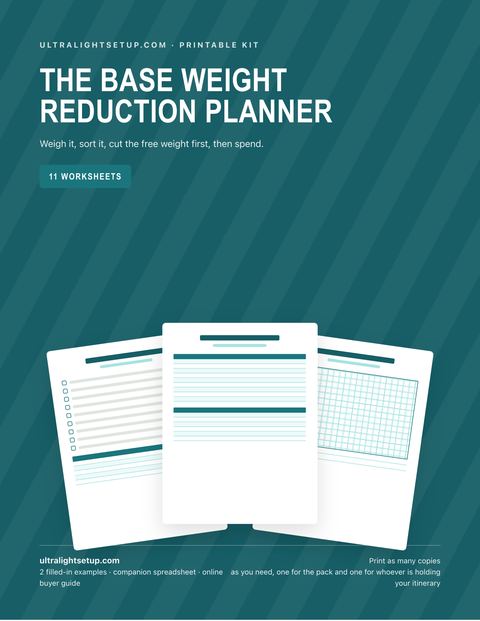
Weighing your own kit item by item? The Base Weight Reduction Planner is the paid version of these pages: 11 printable worksheets you fill in with your own numbers, two filled-in examples, a companion spreadsheet and the full PDF, $29.