Rechargeable vs AAA Headlamp for Backpacking
A rechargeable headlamp is lighter, has no ongoing cost and is usually brighter for the weight. A AAA headlamp lets you carry spare cells, which means the light cannot be flattened by a dead power bank, and it works in the cold on lithium primaries. On short trips rechargeable wins easily. On long remote trips the ability to carry spares is genuinely useful.
At a glance
| Nitecore NU25 UL, 400 lumens, USB-C | Black Diamond Spot 400, AAA powered | |
|---|---|---|
| Power source | Internal lithium cell, USB-C | Three AAA cells |
| Weight | Around 45 g | Around 80 g with cells |
| Resupply | Needs a power bank or mains | Cells available almost anywhere |
| Cold weather | Capacity falls in the cold | Lithium primaries perform well in cold |
| Long trip strategy | Budget the charge into your power plan | Carry a spare set of cells |
| Water resistance | Rated for weather | Rated for weather |
Choose the Nitecore NU25 UL, 400 lumens, USB-C if…
Choose the rechargeable light for most trips. It is lighter, it costs nothing to run, and if you are already carrying a power bank for a phone then the marginal cost of charging a headlamp is small. Know its actual runtime at the setting you use rather than at its lowest, and top it up at every opportunity rather than waiting until it is low.
Check Nitecore NU25 UL, 400 lumens, USB-C on Amazon
Choose the Black Diamond Spot 400, AAA powered if…
Choose the AAA light if you are going somewhere remote for a long time, if you expect real cold, or if you want the light to be independent of everything else in your pack. Lithium primary cells are light, they hold up in freezing conditions, and a spare set weighs very little. It is the option that fails least surprisingly, which is the property you want from a light.
Check Black Diamond Spot 400, AAA powered on Amazon
Related
- Nitecore NU25 UL vs Petzl Bindi: two rechargeable ultralight headlamps compared
- Down vs synthetic insulation
- Layering temperature reference
- Base weight calculator
Comparison based on published manufacturer specifications and the general consensus of owner reports. We have not tested these products side by side. Confirm current specifications and prices before buying. As an Amazon Associate we earn from qualifying purchases, at no extra cost to you.
Deciding on a specific model? We review the Nitecore NB10000 Gen II review in full.
Frequently asked questions
Can you charge a headlamp from a power bank while walking?
Yes, and many people do, but plan the cable and the pocket in advance rather than improvising. The real question is total energy: add the headlamp's needs to the phone's before choosing a power bank capacity, because a bank sized for a phone alone will run out sooner than expected once it is charging two things.
Do lithium AAA cells make a difference?
In the cold, a large one. Lithium primaries hold voltage far better than alkaline as temperature falls, and they are lighter. They also do not leak in the way old alkaline cells do, which has ruined many headlamps left in a drawer. For winter use they are worth the extra cost without much argument.
How many hours of light do you need per night?
In summer, often almost none, because you are in a shelter before dark. In late season the nights are long and an hour or two of camp use plus a dark start adds up quickly. Work from your actual trip: number of nights, likely hours in use, and the runtime at the brightness you really use rather than the lowest setting.
Should you carry a backup light?
On anything remote, yes, even if it is only a tiny keychain light. Being without light in the dark, in terrain, is how simple situations become serious. A backup weighing a few grams is the cheapest safety margin in a pack, and the same applies to keeping a charged phone as a last resort rather than a first one.
How we choose: we compare published manufacturer specifications, listed weights, and verified owner reviews across retailers. We do not test gear in person, and every weight quoted here is the manufacturer's figure unless we say otherwise, so weigh your own kit before you trust a total. Going lighter also means carrying less margin, so treat insulation, navigation, water treatment and an emergency plan as fixed costs rather than places to save grams.
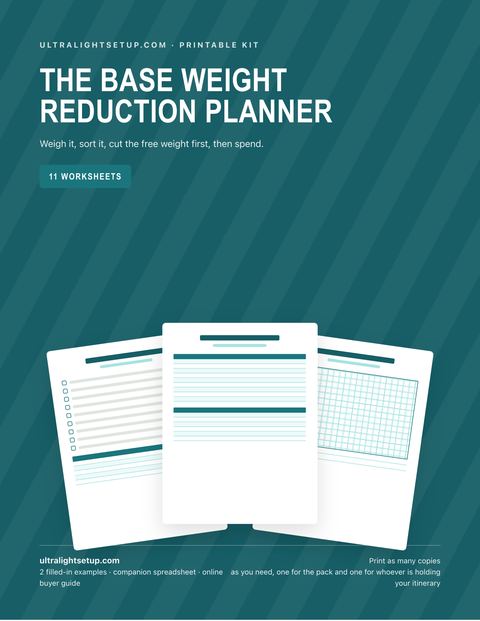
Weighing your own kit item by item? The Base Weight Reduction Planner is the paid version of these pages: 11 printable worksheets you fill in with your own numbers, two filled-in examples, a companion spreadsheet and the full PDF, $29.