SteriPen Ultra Review: 90 Seconds, If the Water Is Clear
A rechargeable UV purifier with a lamp rated for 8,000 treatments and a battery good for about 50 litres per charge, needing a bottle mouth of at least 20 mm. Buy it if your water is clear, you want treatment measured in seconds, and you are prepared to carry a backup. The hard limits are that UV needs clear water to work, it removes nothing physically, and it is an electronic device that can fail with no way to fix it in the field.
Fifty litres per charge and an 8,000 treatment lamp, and nothing at all against silt.
SteriPen Ultra UV Water Purifier, USB Rechargeable
Under $250
A USB rechargeable UV water purifier with an 8,000 treatment lamp, an internal lithium-ion battery and compatibility with pre-filters.
Check price on AmazonSpecifications
| Lamp life | 8,000 treatments |
|---|---|
| Battery | Internal lithium-ion, included |
| Battery life | Up to 50 litres per full charge, or 100 half-litre treatments |
| Minimum bottle diameter | 20 mm, 0.8 in |
| Filter compatibility | Tapered end, FitsAll or pre-filter |
| Charging | USB |
Specifications above come from SteriPen's published specifications. Treat pricing as approximate, since Amazon pricing moves.
What it does well
- Speed. A litre treated in about a minute and a half, with no squeezing, no waiting for chemicals and no flow rate dropping as a filter clogs.
- UV works against viruses as well as bacteria and protozoa, which hollow fibre filters do not. For international travel that is a genuine capability difference.
- It adds no taste and leaves nothing in the water, unlike chemical treatment.
- An 8,000 treatment lamp is far more use than most hikers will get through, so the lamp is not the consumable people worry about.
- Fifty litres per charge covers several days for one person, and it charges from the same power bank as your phone.
Where it falls short
- UV needs clear water. Suspended silt and organic matter shade organisms from the light, so cloudy water must be pre-filtered before treatment or the treatment is unreliable. That is the central limitation and it is not negotiable.
- It removes nothing. Silt, chemicals, heavy metals and taste all remain. A filter physically removes particulate; UV does not.
- It is an electronic device with a battery and a lamp, and it can fail. Unlike a filter, there is nothing you can do about it in the field, so a backup treatment method is not optional.
- It needs a bottle with a mouth of at least 20 mm, so it will not work with every container. Check your bottles before relying on it.
- Cold weather reduces battery performance, and a device that treats 50 litres in summer may manage considerably fewer on a cold trip.
What owners report
Owner reports on SteriPens are split in a predictable way. In clear alpine water people describe them as the fastest and least fussy treatment available. In silty, tannin-stained or agricultural water people describe pre-filtering everything and wondering why they did not just carry a filter. Reliability reports on the electronics are mixed enough that carrying a backup is the near-universal advice.
Our Aquamira drops versus SteriPen comparison is the direct head to head, and our filter versus chemical treatment comparison covers the wider field. Our water treatment guide explains what each method actually removes, which is the thing people are usually confused about.
Carry a backup whichever method you choose. Chemical drops weigh almost nothing and work when a device does not, and our water carry calculator covers the other half of the problem, which is how much you should be carrying between sources.
Who it suits
- Hikers with reliably clear water sources, such as alpine streams and snowmelt.
- International travellers who need protection against viruses that filters do not remove.
- Anyone who hates squeezing water through a filter and wants treatment over in seconds.
Who should skip it
- Silty, tannin-stained or agricultural water, where pre-filtering makes it slower than a filter.
- Anyone unwilling to carry a backup method.
- Cold weather trips, where battery performance falls and electronics are less reliable.
Alternatives worth considering
Platypus Quickdraw Ultralight 1 Litre Backpacking Water Filter System
Under $100
Three point three ounces, three litres per minute squeezed, and a hollow fibre filter meeting NSF and EPA P231 for 99.9999 percent of bacteria and 99.9 percent of protozoa. It removes silt as well, which UV cannot, and it must never freeze.
Check price on AmazonAquamira Water Treatment Drops, 1 oz
Under $25
Chlorine dioxide drops weigh almost nothing, need no power and handle viruses. They need waiting time and a long wait for cryptosporidium. This is what you carry in case the SteriPen fails.
Check price on AmazonNitecore NB10000 Gen II Ultra-Slim Power Bank, 10000 mAh
Under $100
A USB rechargeable purifier is only as good as your power budget. Ten thousand milliamp hours in a slim IPX5 water-resistant body covers a phone, a headlamp and the SteriPen for several days.
Check price on AmazonKeep reading
- Aquamira drops vs SteriPen
- Filter vs chemical water treatment
- Water treatment guide
- Water carry calculator
- Water weight reference
- Platypus Quickdraw review
- Best water filters
This review draws on published specifications, manufacturer figures and the consensus of verified owner reviews. We have not tested this product ourselves, and we say so rather than implying otherwise. As an Amazon Associate we earn from qualifying purchases.
Frequently asked questions
Does a SteriPen work in cloudy water?
Not reliably. UV light has to reach the organisms to inactivate them, and suspended silt or organic matter shades them. Cloudy water must be pre-filtered first, which SteriPen supports with a pre-filter accessory. If your water is routinely cloudy, a filter is the simpler tool.
Does UV remove anything from the water?
No. It inactivates organisms so they cannot reproduce, and everything else stays in the bottle. Silt, chemicals, heavy metals and taste all remain. A filter physically removes particulate and improves clarity; UV does not change the water at all.
Does it work against viruses?
Yes, which is the main advantage over a hollow fibre filter. Most backpacking filters remove bacteria and protozoa and do not remove viruses, which matters in areas with human or agricultural contamination. Chemical treatment also handles viruses.
What happens if it fails?
You have no way to treat water, which is why a backup is not optional. Chemical drops weigh almost nothing and are the standard backup. Any electronic treatment device should be paired with a non-electronic method for exactly this reason.
How long does a treatment take?
About 90 seconds for a litre, stirred through the water in a container with a mouth of at least 20 mm. That is far faster than chemical treatment and comparable to squeezing through a filter, and unlike a filter it does not slow down as it clogs.
How we choose: we compare published manufacturer specifications, listed weights, and verified owner reviews across retailers. We do not test gear in person, and every weight quoted here is the manufacturer's figure unless we say otherwise, so weigh your own kit before you trust a total. Going lighter also means carrying less margin, so treat insulation, navigation, water treatment and an emergency plan as fixed costs rather than places to save grams.
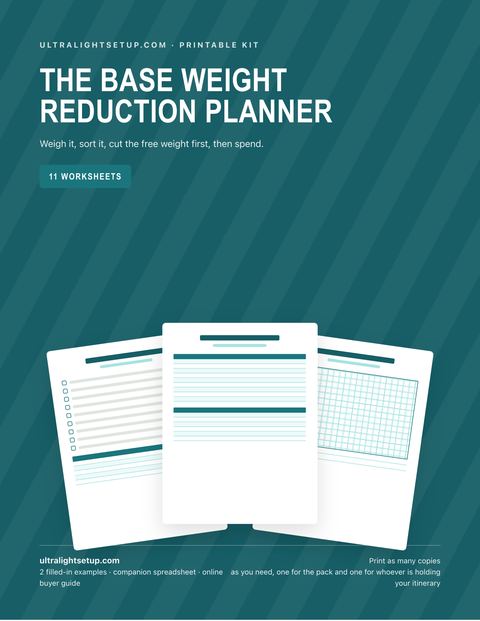
Weighing your own kit item by item? The Base Weight Reduction Planner is the paid version of these pages: 11 printable worksheets you fill in with your own numbers, two filled-in examples, a companion spreadsheet and the full PDF, $29.