SOTO WindMaster Review: The Stove That Works in Wind
Two thousand eight hundred kilocalories an hour with a regulator, a concave burner head that creates a built-in windscreen effect, a stealth igniter protected in the burner post, and the 4Flex four-arm support for larger pots. Buy it if you cook in wind, because a stove that keeps its flame is worth more than one that boils faster in still air. The specific thing to know is that the pot support detaches, and a detachable part is a part you can lose.
A concave burner head that acts as a windscreen, and four pot support arms you can lose.
SOTO WindMaster Backpacking Stove with 4Flex, canister not included
Under $100
A regulated canister stove with a concave burner head, protected stealth igniter and a detachable four-arm pot support for larger cookware.
Check price on AmazonSpecifications
| Output | 2,800 kcal/h, 3,260 W, 11,000 BTU |
|---|---|
| Boil time | 2 cups of water in under 2.5 minutes |
| Burn time | About 1.5 hours on an 8 oz, 250 g canister |
| Fuel | Butane, isobutane and propane mixtures; SOTO prohibit 100 percent propane |
| Wind performance | Concave burner head with the pot close to the flame creates a built-in windscreen effect |
| Igniter | Stealth igniter installed in the burner post to prevent breakage |
| Pot support | 4Flex four-arm support, with a TriFlex three-arm version sold separately |
| Regulator | Maintains consistent output in windy or cold conditions |
Specifications above come from SOTO's published specifications. Treat pricing as approximate, since Amazon pricing moves.
What it does well
- The concave burner head is the reason to buy it. Recessing the flame and sitting the pot close creates a sheltered burn that keeps working when an open burner is blowing sideways.
- A pressure regulator maintains output as the canister empties and as it cools, which is exactly when unregulated stoves become disappointing.
- The igniter is inside the burner post rather than exposed, which addresses the most common failure on stoves with piezo ignition.
- Four arms rather than three is genuinely more stable for a wide pot, and a stove that tips is worse than a stove that boils slowly.
- About 1.5 hours of burn from a 250 g canister is a usable planning number, which most stove listings do not give you.
Where it falls short
- The 4Flex support detaches. That is what allows the stove to pack small and it means there is a separate part that can be dropped in the dark or left on a rock. Pack it with the stove, every time.
- SOTO prohibit 100 percent propane. Use butane, isobutane and propane mixtures as specified, and read the canister rather than assuming.
- Upright canister stoves lose pressure as the canister cools, and a regulator mitigates that rather than eliminating it. In real cold, keep the canister warm or use a stove designed for inverted operation.
- The canister is not included and the fuel is the running cost. Budget the canister and plan for the fact that partial canisters accumulate.
- It is roughly forty percent more expensive than the obvious alternative, and in still weather the difference in performance is small.
What owners report
The WindMaster has an unusually strong reputation among long-distance hikers specifically for wind performance, and owner reports back that up: people who switched from an open-burner stove describe the difference as the stove finally being usable outside a shelter. The recurring practical complaint is the detachable pot support, which people lose.
Our PocketRocket 2 versus WindMaster comparison is the direct head to head, and our BRS-3000T versus WindMaster comparison covers the budget end, where a stove costing a fifth as much works fine in still air and poorly in wind.
Fuel planning is the other half. Our food planning guide and the food weight calculator cover how much cooking you are actually doing, and our canister versus alcohol stove comparison covers the system choice, including the fire restrictions that rule alcohol out in many places.
Who it suits
- Anyone who cooks outside in exposed places rather than in a vestibule.
- Hikers who want a stove that performs consistently as the canister empties.
- Cooks using wider pots, where four support arms matter.
Who should skip it
- Hikers who only boil water in sheltered conditions, where a cheaper stove does the same job.
- Anyone who loses small parts, given the pot support detaches.
- Serious cold weather trips, where an inverted canister or liquid fuel stove is the more capable tool.
Alternatives worth considering
MSR PocketRocket 2 Ultralight Camping and Backpacking Stove
Under $50
Two point six ounces, boiling a litre in about 3.5 minutes, with serrated pot supports and no separate parts to lose. It has no igniter and no regulator, and it is more affected by wind.
Check price on AmazonBRS BRS-3000T Ultra-Light Titanium Alloy Miniature Camping Gas Stove
Under $25
A titanium stove weighing almost nothing at a fraction of the price. It works, it is poor in wind, the supports are small and it is the honest budget answer for still-air boiling.
Check price on AmazonTOAKS LIGHT Titanium 550 ml Pot, ultralight version
Under $50
A 550 ml titanium pot for one person boiling water. Pot size drives stove choice more than people expect, and a narrow pot works better with a three-arm support than a four-arm one.
Check price on AmazonKeep reading
- MSR PocketRocket 2 vs SOTO WindMaster
- BRS-3000T vs SOTO WindMaster
- MSR PocketRocket 2 vs SOTO WindMaster: weight, wind and price
- Canister vs alcohol stove
- TOAKS 550 vs 750 titanium pot
- Ultralight food planning
- MSR PocketRocket 2 review
- Best ultralight stoves
This review draws on published specifications, manufacturer figures and the consensus of verified owner reviews. We have not tested this product ourselves, and we say so rather than implying otherwise. As an Amazon Associate we earn from qualifying purchases.
Frequently asked questions
Is the SOTO WindMaster actually windproof?
It is far better in wind than an open-burner stove. The concave burner head recesses the flame and the pot sits close to it, which creates a sheltered burn. It is not immune to wind, and in a real blow you still want a rock or a pack as a windbreak, sited so it does not trap heat around the canister.
Can I use any gas canister?
Use butane, isobutane and propane mixtures. SOTO state that 100 percent propane is prohibited, so read the canister rather than assuming. Threaded self-sealing canisters are widely available, which is the main practical advantage of a canister stove over anything else.
Does the pot support really come off?
Yes. The 4Flex support detaches from the burner, which is how the stove packs small and why people lose it. Store it inside the pot with the stove, every single time. A TriFlex three-arm version is available separately for narrower pots.
WindMaster or PocketRocket 2?
The PocketRocket 2 is lighter, cheaper and has nothing to lose. The WindMaster is regulated, has an igniter and holds its flame in wind. If you cook outdoors in exposed places, the WindMaster earns the difference. If you boil water in a vestibule, the PocketRocket does the same job.
How much fuel do I need?
SOTO state about 1.5 hours of burn from a 250 g canister, which is a useful planning figure. Count your boils rather than your days: most hikers boil half a litre twice a day, which is a few minutes of burn per boil. Cold weather and wind both increase consumption.
How we choose: we compare published manufacturer specifications, listed weights, and verified owner reviews across retailers. We do not test gear in person, and every weight quoted here is the manufacturer's figure unless we say otherwise, so weigh your own kit before you trust a total. Going lighter also means carrying less margin, so treat insulation, navigation, water treatment and an emergency plan as fixed costs rather than places to save grams.
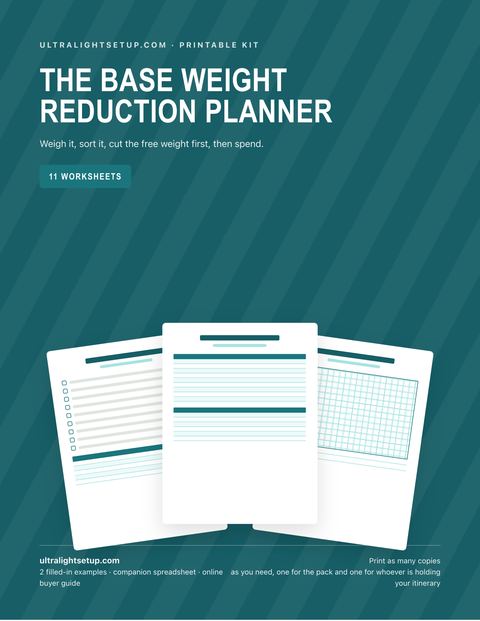
Weighing your own kit item by item? The Base Weight Reduction Planner is the paid version of these pages: 11 printable worksheets you fill in with your own numbers, two filled-in examples, a companion spreadsheet and the full PDF, $29.