MSR PocketRocket 2 Review: 2.6 oz and Nothing to Lose
Two point six ounces, boiling a litre in about three and a half minutes, folding to 2 by 2 by 3 inches with serrated pot supports that handle a range of pot sizes, and a case included. Buy it as the default canister stove, because it is light, simple and there is nothing on it to break or lose. Two things to know: there is no igniter, so you carry a lighter, and it is an open burner, which means wind hurts it.
A litre boiled in three and a half minutes from a stove the size of a matchbox, with no igniter.
MSR PocketRocket 2 Ultralight Camping and Backpacking Stove
Under $50
A 2.6 oz folding canister stove that boils a litre in 3.5 minutes, with serrated pot supports, an adjustable flame and a protective case.
Check price on AmazonSpecifications
| Weight | 2.6 oz, or 4.2 oz with the case |
|---|---|
| Boil time | 1 litre in 3.5 minutes |
| Flame control | Adjustable from a simmer to a rolling boil |
| Fuel | High-performance isobutane-propane canister, not included |
| Setup | No priming, preheating or pressurising required |
| Pot supports | Serrated, accommodating a wide range of pot sizes |
| Dimensions | 4.8 x 4.8 x 3.6 in open, collapsing to 2 x 2 x 3 in |
| Included | Lightweight protective case |
Specifications above come from MSR's published specifications. Treat pricing as approximate, since Amazon pricing moves.
What it does well
- Two point six ounces is genuinely light, and unlike the lightest stoves it is a proper MSR product with support and spares behind it.
- The supports fold with the stove, so there are no separate parts to lose. Every part is attached, which is a real advantage over stoves with detachable supports.
- Serrated supports grip a pot properly, which is what stops dinner sliding off in the dark.
- Real flame control means you can simmer rather than only boil, which matters if you cook rather than rehydrate.
- A litre in three and a half minutes is quick, and threaded isobutane-propane canisters are available almost everywhere in the world.
Where it falls short
- There is no igniter. That is one fewer thing to fail and it means a lighter or matches are mandatory kit, kept dry and duplicated. A stove you cannot light is not a stove.
- It is an open burner, so wind takes the flame sideways and boil times climb. A windbreak helps, and it must be sited so it does not trap heat around the canister.
- It is not regulated. As the canister empties and cools, output falls, which is most noticeable at the end of a canister and in cold weather.
- The canister is not included and never is, and fuel availability is the thing to check when travelling, since canisters cannot be flown.
- Serrated supports work with most pots and a very wide pot on a small stove is still unstable. Match the pot to the stove rather than assuming.
What owners report
The PocketRocket line has one of the longest reliability records in backpacking stoves and owner reports reflect it: it works, it keeps working, and there is nothing to go wrong. The consistent criticisms are wind performance and the absence of an igniter, both of which are design choices rather than faults.
Our PocketRocket 2 versus WindMaster comparison is the direct head to head. The WindMaster costs more, adds a regulator and an igniter, and keeps its flame in wind. If you cook in exposed places that is worth paying for; if you boil water in a vestibule it is not.
At the other end, our BRS-3000T comparison covers the stove that costs a third as much and weighs less. Our canister versus alcohol comparison covers the system decision, including fire restrictions that make alcohol stoves illegal in many places at certain times.
Who it suits
- Anyone who wants a light, simple, reliable stove with nothing to lose.
- Hikers who cook in a vestibule or in sheltered spots.
- Travellers, since threaded isobutane-propane canisters are available almost everywhere.
Who should skip it
- Hikers who regularly cook in exposed wind, where a shielded burner is worth the money.
- Anyone who wants an igniter built in.
- Cold weather trips where a regulated or inverted-canister stove performs better.
Alternatives worth considering
SOTO WindMaster Backpacking Stove with 4Flex, canister not included
Under $100
A concave burner head that shelters the flame, a pressure regulator that holds output as the canister empties, and a protected igniter. More money, and the pot support detaches and can be lost.
Check price on AmazonBRS BRS-3000T Ultra-Light Titanium Alloy Miniature Camping Gas Stove
Under $25
Lighter and far cheaper, with small pot supports and poor wind performance. It is the honest budget answer for boiling water in still air and it is not built to the same standard.
Check price on AmazonTOAKS Titanium 750 ml Pot
Under $50
Seven hundred and fifty millilitres is enough to boil for one person with room to stir, and it fits a small canister inside for packing. Pot size and stove support geometry should be chosen together.
Check price on AmazonKeep reading
- MSR PocketRocket 2 vs SOTO WindMaster
- BRS-3000T vs SOTO WindMaster
- MSR PocketRocket 2 vs SOTO WindMaster: weight, wind and price
- Canister vs alcohol stove
- TOAKS 550 vs 750 titanium pot
- Ultralight food planning
- SOTO WindMaster review
- Best ultralight stoves
This review draws on published specifications, manufacturer figures and the consensus of verified owner reviews. We have not tested this product ourselves, and we say so rather than implying otherwise. As an Amazon Associate we earn from qualifying purchases.
Frequently asked questions
Does the PocketRocket 2 have an igniter?
No. You light it with a lighter or matches, which is one fewer thing to break and one more thing you must carry. Keep a lighter in your cook kit and a backup somewhere else in the pack, because a stove you cannot light is dead weight.
How does it perform in wind?
Less well than a shielded stove. It is an open burner, so wind pushes the flame off the pot and boil times climb. A windbreak helps considerably, and it must be positioned so it does not trap heat around the canister, which is a genuine safety issue.
How much fuel will I use?
Count boils rather than days. Most hikers boil around half a litre twice a day, and a small canister covers several days of that in fair conditions. Wind and cold both increase consumption meaningfully, so plan margin for either.
Can I fly with the canister?
No. Gas canisters cannot be carried in checked or hand baggage on commercial flights. Plan to buy fuel at your destination, and check availability before you travel, because threaded isobutane canisters are common but not universal.
PocketRocket 2 or WindMaster?
The PocketRocket is lighter, cheaper and simpler with no separate parts. The WindMaster is regulated, has an igniter and keeps its flame in wind. If you cook outside in exposed places, the WindMaster is worth the difference. Otherwise the PocketRocket does the same job for less.
How we choose: we compare published manufacturer specifications, listed weights, and verified owner reviews across retailers. We do not test gear in person, and every weight quoted here is the manufacturer's figure unless we say otherwise, so weigh your own kit before you trust a total. Going lighter also means carrying less margin, so treat insulation, navigation, water treatment and an emergency plan as fixed costs rather than places to save grams.
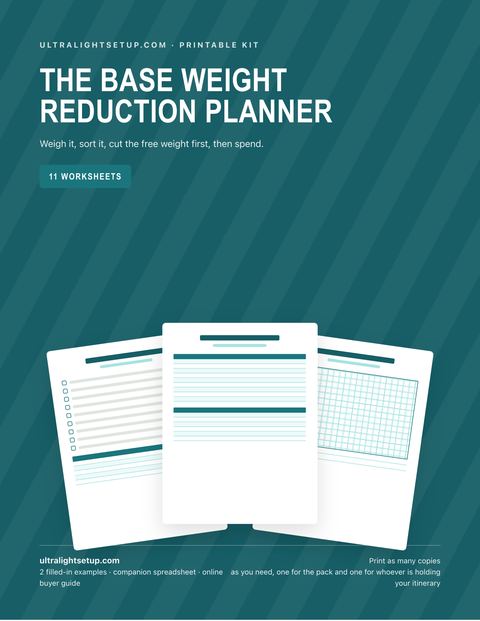
Weighing your own kit item by item? The Base Weight Reduction Planner is the paid version of these pages: 11 printable worksheets you fill in with your own numbers, two filled-in examples, a companion spreadsheet and the full PDF, $29.