NEMO Hornet OSMO 2P Review: Light, and Genuinely Small
A two-door, two-vestibule freestanding tent in NEMO's OSMO fabric, which the maker states has four times better water repellency and three times less stretch when wet than the material it replaced. Buy it if you want a light freestanding double-wall tent and you are usually solo or a close pair. Skip it if two adults need room to sit up and sort gear, because saving weight in a tent this size is done by making the tent smaller.
A freestanding two-person tent light enough to justify itself, in a footprint that two adults will find cosy.
NEMO Equipment Hornet OSMO Backpacking Tent, 2P, Birch Bud and Goodnight Gray
Under $500
A two-person double-wall tent in OSMO poly-nylon ripstop, with two doors and vestibules, a Flybar volumizing pole clip and volumizing guy-outs.
Check price on AmazonSpecifications
| Fabric | Proprietary OSMO poly-nylon ripstop, from 100 percent recycled yarns, PFAS-free |
|---|---|
| Water repellency | NEMO state 4 times better repellency and 3 times less stretch when wet |
| Doors | Two, with large vestibules for each occupant |
| Head room | Patent-pending Flybar volumizing pole clip adds room at the head and spreads fly tension |
| Walls | Volumizing guy-outs pull the inner sidewalls outward |
| Doors | Integrated Gatekeeper clips for one-handed tie-back |
Specifications above come from NEMO's published product information. Treat pricing as approximate, since Amazon pricing moves.
What it does well
- Two doors and two vestibules is the specification that decides whether two people can live in a tent. Climbing over your partner at 3am is what turns a light tent into a bad one.
- OSMO fabric addresses the real weakness of silnylon, which is that it stretches when wet and needs re-tensioning in the night. Less stretch means a pitch that holds.
- Freestanding matters more than ultralight forums admit. On rock, on wooden platforms and on frozen ground, a tent that needs stakes to stand up is a problem.
- The volumizing guy-outs and the Flybar are addressing the specific failing of tapered ultralight tents, which is that the walls close in on your face.
- Double wall construction means condensation forms on the fly and not on the inner, which is the single biggest comfort difference from a single-wall shelter.
Where it falls short
- It is a small two-person tent. Ultralight tents get light by getting smaller, and two adults with wide shoulders will be touching. If you value space, look at the weight of a three-person tent instead.
- Light fabrics are less durable. A 2P tent at this weight wants a groundsheet or a careful site, and pitching it on sharp ground is how they get punctured.
- Freestanding is more weight than a trekking pole shelter for the same floor area. A trekking pole tent uses poles you were carrying anyway.
- The OSMO performance figures are NEMO's own comparative claims rather than an independent test, and they are stated relative to their previous fabric rather than to any absolute standard.
- It is not cheap. At this price a trekking pole shelter plus a good pad upgrade is an alternative use of the money.
What owners report
Owner reports on the Hornet family are consistent: light, well made, and tight for two. People who use the 2P solo describe it as excellent, and people who use it as a genuine two-person tent describe it as workable rather than comfortable. The OSMO fabric draws positive comments specifically on how the pitch holds through a wet night.
The comparison most buyers are making is covered in our Lunar Solo versus Copper Spur comparison and our trekking pole versus freestanding comparison. The trade is straightforward: freestanding gives you pitch flexibility and costs weight; trekking pole shelters use poles you already carry and demand a stakeable site.
Shelter is one of the Big Three, and it is where base weight is won or lost. Our Big Three guide and the base weight calculator put the tent in context against your pack and sleep system rather than treating it in isolation.
Who it suits
- Solo hikers who want a palace, or pairs who are comfortable sharing a small space.
- Anyone camping on rock, platforms or ground that will not take a stake.
- Hikers who want double-wall condensation behaviour without a heavy tent.
Who should skip it
- Two adults who want room to sit up and sort gear.
- Hikers already carrying trekking poles, for whom a pole-supported shelter is lighter for the same space.
- Rough campsites where a fragile floor is a liability.
Alternatives worth considering
Big Agnes Copper Spur HV UL2 Ultralight Bikepacking Tent
Under $500
A four-way high-volume hub design that Big Agnes state increases usable interior volume by 20 percent over the previous version, with two doors and two vestibules. Note this listing is the bikepack variant with a bike-specific stuff sack.
Check price on AmazonSix Moon Designs Lunar Solo Ultralight Backpacking Tent, 26 oz, trekking pole setup
Under $500
Twenty six ounces of silicone-coated polyester pitched with a trekking pole. Far lighter and cheaper for one person, at the cost of single-wall condensation and needing ground that takes stakes.
Check price on AmazonNaturehike Cloud Up Base Backpacking Tent, 2 Person
Under $250
A quarter of the price for a two-person freestanding tent. Heavier and with less refined fabrics, and it is the honest answer if the shelter budget is what is stopping you getting out.
Check price on AmazonKeep reading
- Trekking pole tent vs freestanding tent
- Lunar Solo vs Copper Spur HV UL2
- Tarp vs bivy
- The Big Three explained
- Base weight calculator
- Tent weight comparison
- Big Agnes Copper Spur HV UL2 review
- Six Moon Designs Lunar Solo review
- Best ultralight tents
This review draws on published specifications, manufacturer figures and the consensus of verified owner reviews. We have not tested this product ourselves, and we say so rather than implying otherwise. As an Amazon Associate we earn from qualifying purchases.
Frequently asked questions
Is the Hornet OSMO 2P big enough for two people?
Two people fit and it is snug. Ultralight two-person tents achieve their weight by reducing floor area and wall angle, so shoulder room and sitting height are where the grams were saved. Many hikers buy the 2P as a spacious solo tent, which is a reasonable use of the extra half pound.
What is OSMO fabric?
NEMO's proprietary poly-nylon ripstop, made from recycled yarns and PFAS-free. NEMO state it has four times better water repellency and three times less stretch when wet than the fabric it replaced. Less stretch when wet is the practical benefit, because it means the pitch stays taut through a rainy night without getting up to re-tension guylines.
Freestanding or trekking pole tent?
Freestanding pitches anywhere including rock and platforms and is heavier. A trekking pole tent uses poles you already carry, so it is lighter overall, and it needs ground that takes stakes and a bit more skill to pitch well. If you already hike with poles and camp on soil, the pole tent is the lighter system.
Do I need a footprint?
Not strictly, and it helps. Ultralight tent floors are thin and a groundsheet extends their life considerably. A piece of polycryo costs a few dollars and weighs a couple of ounces, which is a better trade than the branded footprint for most hikers.
How much should a two-person tent weigh?
For a light double-wall freestanding tent, somewhere in the low three pound range is competitive, and trekking pole shelters go well below that. What matters more is the weight per person, since a two-person tent split between two hikers is a very different figure from carrying it solo.
How we choose: we compare published manufacturer specifications, listed weights, and verified owner reviews across retailers. We do not test gear in person, and every weight quoted here is the manufacturer's figure unless we say otherwise, so weigh your own kit before you trust a total. Going lighter also means carrying less margin, so treat insulation, navigation, water treatment and an emergency plan as fixed costs rather than places to save grams.
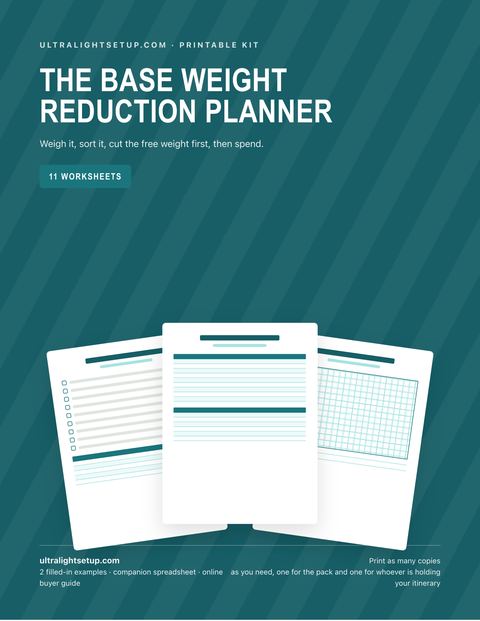
Weighing your own kit item by item? The Base Weight Reduction Planner is the paid version of these pages: 11 printable worksheets you fill in with your own numbers, two filled-in examples, a companion spreadsheet and the full PDF, $29.