Tarp vs Bivy: Two Different Ways to Sleep Light
These solve the same problem in opposite directions. A tarp gives you a large dry area, room to cook and pack, and excellent airflow, at the cost of no floor, no insect protection and exposure to blowing rain. A bivy wraps the sleeping bag, is weatherproof from every direction and is small enough to sleep almost anywhere, at the cost of space and serious condensation.
At a glance
| LiteOutdoors silnylon tarp, 8 by 10 ft | Sierra Designs Backcountry Bivy | |
|---|---|---|
| Floor | None, carry a groundsheet | Integrated |
| Insect protection | None without a separate net | Usually a head net section |
| Space | Large, room to sit and cook | Sleeping bag only |
| Condensation | Low, open airflow | High, moisture collects inside |
| Blowing rain | Gets underneath in wind | Sheds it |
| Pitch requirements | Needs stakes and usually poles or trees | Anywhere flat |
Choose the LiteOutdoors silnylon tarp, 8 by 10 ft if…
Choose a tarp if you want somewhere dry to exist rather than only somewhere dry to sleep. Being able to sit up, cook under cover and repack in the rain changes a wet day completely, and the airflow means very little condensation. You will need a groundsheet, a plan for insects, and enough practice to pitch it low and tight when the weather turns, which is a skill rather than a purchase.
Check LiteOutdoors silnylon tarp, 8 by 10 ft on Amazon
Choose the Sierra Designs Backcountry Bivy if…
Choose a bivy if you sleep in places a tarp cannot be pitched, if you move fast and light, or if you want the smallest possible packed size. It is weatherproof from every direction and it needs no stakes. Understand what you are accepting: there is no room for anything but you, moisture from your own breath and body collects inside it, and a full day of rain in a bivy is genuinely unpleasant.
Check Sierra Designs Backcountry Bivy on Amazon
Related
- Backpacking fabric denier and weight chart, for what a tarp or bivy is made from
- Trekking pole vs freestanding tent
- Tent weight comparison
- Complete gear lists by trip type
Comparison based on published manufacturer specifications and the general consensus of owner reports. We have not tested these products side by side. Confirm current specifications and prices before buying. As an Amazon Associate we earn from qualifying purchases, at no extra cost to you.
Deciding on a specific model? We review the NEMO Hornet OSMO 2P review, Six Moon Designs Lunar Solo review and Sea to Summit Ultra-Sil Nano Tarp Poncho review in full.
Frequently asked questions
Do bivies really get that damp inside?
Yes, and it is inherent rather than a design flaw. You give off moisture all night, the bivy has very little internal volume, and even a breathable membrane cannot move that much vapour when the outside is cold and wet. Expect a damp bag by morning in humid conditions, plan to dry it when the sun appears, and prefer a synthetic or a treated down fill if bivy use is regular.
Can you use both together?
Yes, and it is a common and sensible combination. A tarp over a light bivy gives you the dry working space of a tarp and the splash protection and warmth of the bivy, and the two together often weigh less than a tent. It is more to set up and it needs more skill, which is the honest cost.
Is either safe in serious weather?
Both can be, with skill and site choice, and both can fail badly without them. A tarp pitched low and tight to the wind sheds a lot of weather; the same tarp pitched high catches it and can be destroyed. A bivy is weatherproof but leaves you with nowhere to wait out a storm. If you expect sustained severe weather, a tent is the appropriate shelter and the weight is the price of that margin.
What about insects?
This is the practical thing that ends most tarp experiments. In mosquito or midge season, a tarp alone is miserable and a bug bivy or an inner net is effectively mandatory, which adds weight and cost. Plan for the season you are actually walking in rather than the one in the photographs.
How we choose: we compare published manufacturer specifications, listed weights, and verified owner reviews across retailers. We do not test gear in person, and every weight quoted here is the manufacturer's figure unless we say otherwise, so weigh your own kit before you trust a total. Going lighter also means carrying less margin, so treat insulation, navigation, water treatment and an emergency plan as fixed costs rather than places to save grams.
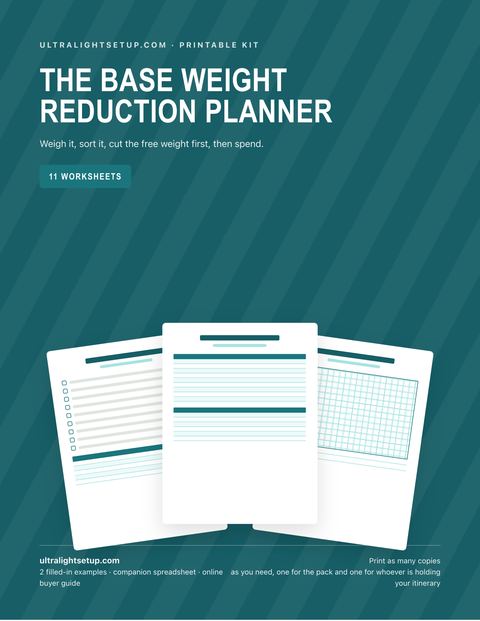
Weighing your own kit item by item? The Base Weight Reduction Planner is the paid version of these pages: 11 printable worksheets you fill in with your own numbers, two filled-in examples, a companion spreadsheet and the full PDF, $29.