Six Moon Lunar Solo vs Big Agnes Copper Spur HV UL2
The Lunar Solo is far lighter and cheaper because it uses your trekking poles and has one wall. The Copper Spur is freestanding, double walled and much easier to pitch anywhere, including on rock and platforms. The real trade is condensation and site choice: a single wall tent will wet the inside on a still humid night, and a freestanding tent will not need stakes to hold its shape.
At a glance
| Six Moon Designs Lunar Solo, one person | Big Agnes Copper Spur HV UL2 | |
|---|---|---|
| Structure | Trekking poles required | Freestanding with its own poles |
| Walls | Single wall | Double wall with an inner and a fly |
| Weight | Around 26 oz | Around 3 lb for the two person |
| Condensation | Common, wipe down in the morning | Much less inside the inner |
| Pitch sites | Needs ground that takes stakes | Works on rock, platforms and hard ground |
| Capacity | One person | Two, or one with room |
Choose the Six Moon Designs Lunar Solo, one person if…
Choose the Lunar Solo if you already carry trekking poles and pitch on ground that takes stakes. It saves a substantial amount of weight and money at once, which is rare. Plan for condensation: a single wall tent in still humid conditions will have water on the inside of the fabric by morning, so keep your quilt off the walls and carry a small cloth. In wind and rain it pitches low and sheds weather well once you know it.
Check Six Moon Designs Lunar Solo, one person on Amazon
Choose the Big Agnes Copper Spur HV UL2 if…
Choose the Copper Spur if you camp on hard ground, rock slabs, wooden platforms or anywhere stakes will not hold, or if you want a tent that is forgiving to pitch when you arrive tired in the dark. The double wall keeps condensation on the fly rather than on you, and the inner gives you insect protection and a defined dry space. It costs more, weighs more and pitches almost anywhere.
Check Big Agnes Copper Spur HV UL2 on Amazon
Related
Comparison based on published manufacturer specifications and the general consensus of owner reports. We have not tested these products side by side. Confirm current specifications and prices before buying. As an Amazon Associate we earn from qualifying purchases, at no extra cost to you.
Deciding on a specific model? We review the NEMO Hornet OSMO 2P review, Big Agnes Copper Spur HV UL2 review and Six Moon Designs Lunar Solo review in full.
Frequently asked questions
How bad is condensation in a single wall tent?
It varies with conditions and it is worst on still, humid nights near water, which are common. You will wake to moisture on the inside of the fabric, and anything touching that fabric will get wet. Site choice helps a great deal: pitch slightly higher than the valley floor, away from still water, and with some airflow through the tent.
What happens if you lose or break a trekking pole?
Your shelter has no structure, which is why this matters more than it sounds. A cord run to a tree branch will get you through a night, and a repair sleeve carried for the poles is a better answer. If you are going somewhere without trees and without a spare, that is a real risk to plan for rather than a theoretical one.
Is a two person tent worth carrying for one?
Often yes, and it is one of the more sensible weight compromises. The extra space for gear, for sitting out a wet day and for a pack indoors is genuinely useful, and modern two person tents are not much heavier than one person ones. Shared between two people, the per person weight is far lower than either carrying a solo tent.
Does saving weight on a shelter cost you safety?
It can, and this is the part ultralight discussion often skips. A lighter shelter usually means less headroom, less coverage, thinner fabric and more dependence on a good pitch. In fair conditions none of that matters. In a night of driving rain and wind it all does. Choose a shelter for the worst weather you might genuinely meet, not the average.
How we choose: we compare published manufacturer specifications, listed weights, and verified owner reviews across retailers. We do not test gear in person, and every weight quoted here is the manufacturer's figure unless we say otherwise, so weigh your own kit before you trust a total. Going lighter also means carrying less margin, so treat insulation, navigation, water treatment and an emergency plan as fixed costs rather than places to save grams.
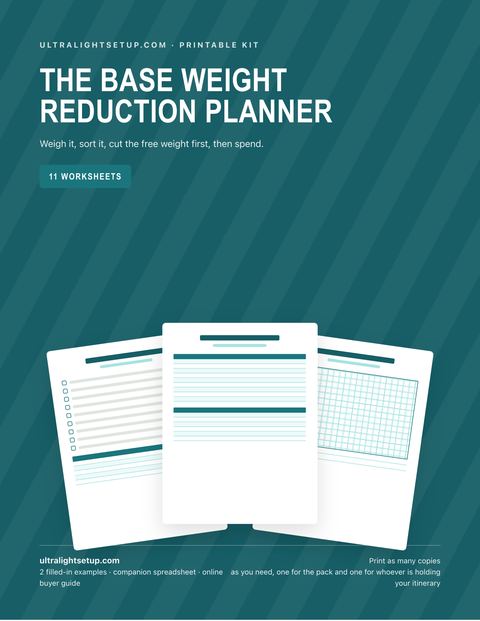
Weighing your own kit item by item? The Base Weight Reduction Planner is the paid version of these pages: 11 printable worksheets you fill in with your own numbers, two filled-in examples, a companion spreadsheet and the full PDF, $29.