Garmin inReach Mini 2 Weight: 3.5 oz (100 g), Specs and Price
The Garmin inReach Mini 2 weighs 100 g (3.5 oz) according to Garmin, about 2 percent of a 10 lb ultralight base weight. Garmin rates the battery at up to 14 days with 10 minute tracking and up to 30 days at 30 minute tracking. Its budget tier is under $500, the retailer page shows the current price, and every plan needs a paid satellite subscription.
The Garmin inReach Mini 2 Satellite Communicator is our expert tier pick in headlamps and electronics, with a published weight of 3.5 oz , in the under $250 budget tier. Two way messaging and an SOS button that works with no cell coverage at all, for three and a half ounces plus a subscription. This is the one item on the site we would never tell you to cut to hit a weight target.
Garmin inReach Mini 2 specs at a glance
| Weight | 100 g (3.5 oz), Garmin published figure |
|---|---|
| Battery life | Up to 14 days at 10 minute tracking, up to 30 days at 30 minute tracking |
| Satellite network | Iridium, global coverage |
| SOS | Interactive SOS to a 24/7 emergency response center |
| Messaging | Two way text messages with no cell signal |
| Charging | USB-C |
| Subscription | Required for messaging, tracking and SOS |
| Budget | Under $500; the retailer page shows the current price |
Sources: Garmin inReach Mini 2 product specifications (weight, battery life, network, features) and Garmin subscription information. Satellite messengers support rescue but do not guarantee it. Researched, not professional advice.
What is the Garmin inReach Mini 2 Satellite Communicator actually good at?
Two way messaging and an SOS button that works with no cell coverage at all, for three and a half ounces plus a subscription. This is the one item on the site we would never tell you to cut to hit a weight target.
Best for: Solo hikers, anyone off trail, and anyone whose family needs to know they are fine.
Electronics are the category where ounces come off cheaply. A purpose built ultralight headlamp and power bank together save close to half a pound against the consumer versions, and neither one costs much more.
What does it do to your base weight?
At 3.5 oz this item accounts for roughly 2 percent of a 10 lb ultralight base weight and about 1 percent of a 20 lb traditional one. That framing matters more than the raw number: an ounce saved on a headlamp is noise, and a pound saved on a shelter is a category of its own. Put your real figures into the gear list builder and the same item will show you what it costs against your list rather than against an average one.
Published weights are taken in the manufacturer's favour: usually the smallest size, usually without the stuff sack, stakes or guylines that come in the box. Expect a real-world figure an ounce or two heavier and weigh it once when it arrives. A kitchen scale under $25 is the cheapest useful upgrade to any gear list, because it stops the spreadsheet lying to you.
How does it compare with the rest of the headlamps and electronics?
Every item below has been verified against the retailer listing, and every weight is the manufacturer's published figure for the configuration named. Sorted lightest first, so the trade between weight and everything else is visible in one pass.
| Model | Published weight | Budget | Tier | Where to buy |
|---|---|---|---|---|
| Garmin inReach Mini 2 Satellite Communicator | 3.5 oz | Under $250 | Expert | Backcountry, Amazon |
| Nitecore NU25 UL 400 Lumen Headlamp | 1.6 oz | Under $50 | Beginner | Backcountry, Amazon |
| Black Diamond Spot 400-R Headlamp | 2.6 oz | Under $100 | Intermediate | Backcountry, Amazon |
| Nitecore NB10000 Gen 2 Power Bank | 5.3 oz | Under $100 | Intermediate | Backcountry, Amazon |
Lighter alternatives: Nitecore NU25 UL 400 Lumen Headlamp at 1.6 oz, Black Diamond Spot 400-R Headlamp at 2.6 oz. Heavier but more capable: Nitecore NB10000 Gen 2 Power Bank at 5.3 oz. Weight alone never decides this. The lightest option in a category is usually the one with the narrowest window of conditions it works in, which is exactly the trade the roundup spells out tier by tier.
Batteries, cold, and what actually needs charging
Battery capacity drops in the cold, sometimes sharply, so a power bank that covers four days in summer may not cover three in shoulder season, and the fix is to keep it inside your quilt overnight rather than to carry a second one. Work out the real requirement before buying capacity: a phone used for navigation with the screen mostly off is a far smaller draw than most people assume, and a 10,000 mAh bank is two to three phone charges, which covers a standard four day resupply window. A satellite messenger is the one item on this site we would never suggest cutting to hit a weight target.
What does the weight saving cost per dollar?
Gear upgrades get argued in adjectives. They are better argued in a ratio. Against the heaviest priced option on the same shelf, the Nitecore NB10000 Gen 2 Power Bank at 5.3 oz (under $100), this item saves 1.8 oz and is several times the price of it. The retailer pages show the current prices, so you can work out the grams saved per dollar on the day you buy.
Use grams per dollar the way you would use any ratio, which is as a sanity check rather than a verdict. Anything above roughly 5 grams per dollar is excellent value in this hobby. Under about 1 gram per dollar you are buying something because you want it, not because the arithmetic told you to, and that is a perfectly good reason as long as you know which one you are doing. The ratio also ignores everything that is not weight: durability, fit, repairability and how well an item works in the conditions you actually hike in are not in the numerator, and any of them can outweigh the whole calculation.
Which complete kits use it?
This item appears in 5 of the complete gear lists on this site, which is the most useful context a single product page can give you: not what it weighs in isolation, but what share of a finished kit it accounts for and what the rest of that kit looks like around it.
| Complete kit | Season | Kit base weight | This item | Share of base | Kit budget |
|---|---|---|---|---|---|
| Sub-10 lb | Three season | 8 lb 12.3 oz | 3.5 oz | 2% | Under $3,500 |
| Thru-hike | Three season, long distance | 9 lb 15.6 oz | 3.5 oz | 2% | Under $3,000 |
| Desert | Desert, spring and autumn, high heat | 11 lb 4.9 oz | 3.5 oz | 2% | Under $3,000 |
| Sub-15 lb | Three season | 13 lb 3.1 oz | 3.5 oz | 2% | Under $3,500 |
| Winter | Winter and cold shoulder season | 17 lb 3.3 oz | 3.5 oz | 1% | Under $5,000 |
Every one of those kits lists every item you need to actually go, with a per item weight and budget tier, a running weight total, a section on what you can skip, and an upgrade ladder ranked by grams saved per dollar. Each also loads straight into the gear list builder so you can swap this item for something you already own and watch the total move. That is usually a faster way to decide whether a purchase is worth it than reading another review of it.
Who should skip it?
Anyone buying their first version of this item. Expert tier gear is specialised, and specialised means it is better at a narrower set of conditions rather than better at everything. Buying it first usually means discovering an expensive preference rather than confirming one.
Going lighter must not mean going unprepared. Shelter adequate to the actual conditions, insulation, rain protection, water treatment and a way to call for help are fixed costs on any list. If a lighter version of this item means cutting into one of those, it is the wrong purchase however good the spec sheet looks. You are responsible for what you walk into, and the forecast is not the conditions.
Related reading
- Our full headlamps and electronics roundup, split into beginner, intermediate and expert tiers
- Base weight tiers chart
- Ultralight packing checklist
- Gear list builder: see what this item does to your own base weight
- Base weight calculator
- Six complete example gear lists, every item with a budget tier and a link
- All verified gear specs, A to Z
Frequently asked questions
How much does the Garmin inReach Mini 2 Satellite Communicator weigh?
The published weight is 3.5 oz, which is 3.5 ounces or about 99 grams. That is roughly 2 percent of a 10 lb ultralight base weight on its own. This figure is the manufacturer's for the size and configuration named, not a weight we measured, and published figures run light often enough that it is worth putting your own scale under it.
Is the Garmin inReach Mini 2 Satellite Communicator worth the money?
Two way messaging and an SOS button that works with no cell coverage at all, for three and a half ounces plus a subscription. This is the one item on the site we would never tell you to cut to hit a weight target. In the under $250 budget tier it sits at the expensive end of its category, and prices move constantly, so check the current price on the retailer page before you buy.
Where can you buy the Garmin inReach Mini 2 Satellite Communicator?
Backcountry carries this category and is the first link on this page, because it is where this audience shops and it pays us a higher commission than Amazon does. Amazon is the second button. Stock and pricing differ between the two often enough that checking both is worth the extra thirty seconds.
What does the Garmin inReach Mini 2 Satellite Communicator compete against?
On the same shelf: Nitecore NU25 UL 400 Lumen Headlamp, Black Diamond Spot 400-R Headlamp, Nitecore NB10000 Gen 2 Power Bank. The comparison table on this page lines them up by published weight and price so the trade is visible rather than argued. Our full ranking of the category, split into beginner, intermediate and expert tiers, is in the roundup linked below.
Are the weights on this page measured or published?
Published. We compare manufacturer specifications and verified owner reviews, and we do not test gear in person or run a gear lab. Manufacturer weights are usually taken from the lightest size, without stuff sacks, stakes or guylines, so a real-world figure is often an ounce or two heavier. Weigh your own kit and put the real numbers into the gear list builder.
How we choose: we compare published manufacturer specifications, listed weights, and verified owner reviews across retailers. We do not test gear in person, and every weight quoted here is the manufacturer's figure unless we say otherwise, so weigh your own kit before you trust a total. Going lighter also means carrying less margin, so treat insulation, navigation, water treatment and an emergency plan as fixed costs rather than places to save grams.
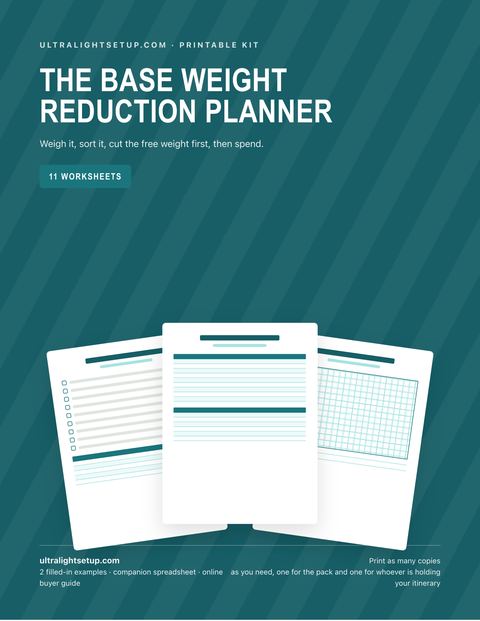
Weighing your own kit item by item? The Base Weight Reduction Planner is the paid version of these pages: 11 printable worksheets you fill in with your own numbers, two filled-in examples, a companion spreadsheet and the full PDF, $29.