Winter Backpacking Gear List
This winter kit has a base weight of 17 lb 3.3 oz (7805 g) and weighs 28 lb 9.4 oz on your back loaded for 2 nights, snow on the ground, temperatures near and below freezing. Shelter, sleep system and pack account for 10 lb 2.4 oz of that, or 59 percent.
Winter is the one place on this site where we argue for carrying more. Margin that is merely nice in July is what keeps a trip survivable in February, and almost every ultralight technique that works in summer trades away exactly the margin you need. This kit lands near seventeen pounds of base weight and about twenty eight pounds on your back, and every extra pound of it is doing a job.
Load this kit into the gear list builder
That link drops all 42 lines into an editable list where you can swap in gear you already own, change quantities and watch base weight move. It is almost always faster than typing a list from a blank page, and it keeps the category definitions consistent with everything else on this site.
Who this is for: Experienced three season backpackers taking a first trip into snow, with the skills and the company to match.
Who it is not for: Anyone whose plan for a cold night is to hike faster. Winter punishes optimism differently to summer.
Every weight below is the manufacturer's published figure for the size and configuration named, and the consumables are stated for a specific trip: 2 nights, snow on the ground, temperatures near and below freezing. A gear list without a stated resupply window is a wish rather than a plan, because food and water are the difference between a 17 lb 3.3 oz base weight and a 28 lb 9.4 oz pack. On this kit consumables are 40 percent of what is actually on your back at the trailhead.
Base weight: what is in the pack
| Item | Weight | Budget | Running total | Where to buy |
|---|---|---|---|---|
| Big Agnes Copper Spur HV UL2 | 3 lb 2.0 oz 1417 g | Under $750 | 3 lb 2.0 oz | Backcountry Amazon |
| MSR Groundhog Tent Stakes, 6 Pack | 2.8 oz 79 g | Under $25 | 3 lb 4.8 oz | Backcountry Amazon |
| Snow stakes and deadman anchors | 4.0 oz 113 g | Under $50 | 3 lb 8.8 oz | Backcountry Amazon |
| Item | Weight | Budget | Running total | Where to buy |
|---|---|---|---|---|
| Sea to Summit Spark 0-Degree Down Sleeping Bag, Regular | 2 lb 1.0 oz 936 g | Under $750 | 5 lb 9.8 oz | Backcountry Amazon |
| Therm-a-Rest NeoAir XLite NXT, Regular | 13.0 oz 369 g | Under $250 | 6 lb 6.8 oz | Backcountry Amazon |
| Therm-a-Rest Z Lite Sol Closed Cell Foam Pad | 14.0 oz 397 g | Under $100 | 7 lb 4.8 oz | Backcountry Amazon |
| Sea to Summit Aeros Ultralight Pillow, Large | 2.1 oz 60 g | Under $50 | 7 lb 6.9 oz | Backcountry Amazon |
| Item | Weight | Budget | Running total | Where to buy |
|---|---|---|---|---|
| Osprey Exos 58 Ultralight Backpacking Pack | 2 lb 10.0 oz 1191 g | Under $500 | 10 lb 0.9 oz | Backcountry Amazon |
| Trash compactor bag as a pack liner | 1.5 oz 43 g | Under $25 | 10 lb 2.4 oz | Backcountry Amazon |
Kitchen
Compare stoves →| Item | Weight | Budget | Running total | Where to buy |
|---|---|---|---|---|
| Jetboil Stash Cooking System | 7.1 oz 201 g | Under $250 | 10 lb 9.5 oz | Backcountry Amazon |
| TOAKS Titanium Long Handle Spork | 0.6 oz 17 g | Under $25 | 10 lb 10.1 oz | Backcountry Amazon |
| Mini lighter | 0.4 oz 11 g | Under $25 | 10 lb 10.5 oz | Backcountry Amazon |
| Ferro rod backup ignition | 0.5 oz 14 g | Under $25 | 10 lb 11.0 oz | Backcountry Amazon |
| Odor resistant food bag and hang line | 1.6 oz 45 g | Under $50 | 10 lb 12.6 oz | Backcountry Amazon |
Water
Compare filters →| Item | Weight | Budget | Running total | Where to buy |
|---|---|---|---|---|
| Wide mouth 1 litre bottles, two, with insulated parkas | 12.4 oz 352 g | Under $50 | 11 lb 9.0 oz | Backcountry Amazon |
| Chlorine dioxide drops | 3.0 oz 85 g | Under $25 | 11 lb 12.0 oz | Backcountry Amazon |
Packed clothing
Compare rain and insulation →| Item | Weight | Budget | Running total | Where to buy |
|---|---|---|---|---|
| Rab Electron Pro 800 Fill Down Hooded Jacket | 15.5 oz 439 g | Under $250 | 12 lb 11.5 oz | Backcountry Amazon |
| Outdoor Research Helium Rain Jacket | 6.3 oz 179 g | Under $250 | 13 lb 1.8 oz | Backcountry Amazon |
| Grid fleece midlayer | 12.0 oz 340 g | Under $100 | 13 lb 13.8 oz | Backcountry Amazon |
| Insulated synthetic pants | 10.0 oz 283 g | Under $250 | 14 lb 7.8 oz | Backcountry Amazon |
| Spare wool socks, two pairs (x2) | 7.2 oz 204 g | Under $50 each | 14 lb 15.0 oz | Backcountry Amazon |
| Insulated gloves and liner gloves | 3.5 oz 99 g | Under $100 | 15 lb 2.5 oz | Backcountry Amazon |
| Balaclava and warm hat | 3.0 oz 85 g | Under $50 | 15 lb 5.5 oz | Backcountry Amazon |
| Down camp booties | 4.0 oz 113 g | Under $100 | 15 lb 9.5 oz | Backcountry Amazon |
Electronics
Compare budget gear →| Item | Weight | Budget | Running total | Where to buy |
|---|---|---|---|---|
| Black Diamond Spot 400-R Headlamp | 2.6 oz 74 g | Under $100 | 15 lb 12.1 oz | Backcountry Amazon |
| Nitecore NB10000 Gen 2 Power Bank | 5.3 oz 150 g | Under $100 | 16 lb 1.4 oz | Backcountry Amazon |
| USB-C charging cable, short | 0.8 oz 23 g | Under $25 | 16 lb 2.2 oz | Backcountry Amazon |
| Garmin inReach Mini 2 Satellite Communicator | 3.5 oz 99 g | Under $250 | 16 lb 5.7 oz | Backcountry Amazon |
Miscellaneous
Compare budget gear →| Item | Weight | Budget | Running total | Where to buy |
|---|---|---|---|---|
| First aid and repair kit, winter | 5.0 oz 142 g | Under $50 | 16 lb 10.7 oz | Backcountry Amazon |
| Titanium trowel | 0.6 oz 17 g | Under $25 | 16 lb 11.3 oz | Backcountry Amazon |
| Toiletries and toilet paper | 3.0 oz 85 g | Under $25 | 16 lb 14.3 oz | Backcountry Amazon |
| Glacier glasses and high SPF sunscreen | 5.0 oz 142 g | Under $100 | 17 lb 3.3 oz | Backcountry Amazon |
Weights are the manufacturer's published figures for the size and configuration named, not figures we measured. Weigh your own kit before you trust a total. Budgets are tiers, not prices, and totals round up to a band; the retailer page shows the current price. We earn commissions from Backcountry and from qualifying Amazon purchases; where a pick is sold only by its maker, the buttons search comparable gear instead.
Where does the base weight actually sit?
The running total column above answers the question people really want, which is not "what does this kit weigh" but "which line pushed it over". The category split below is the same data viewed from a distance. In almost every gear list ever written, the top three rows of this table are the Big Three, and that is exactly why the advice to start there is not just a slogan.
| Category | Weight | Grams | Share of base | Where to go deeper |
|---|---|---|---|---|
| Sleep system | 3 lb 14.1 oz | 1761 | 23% | Best sleeping pads |
| Packed clothing | 3 lb 13.5 oz | 1743 | 22% | Layering system guide |
| Shelter | 3 lb 8.8 oz | 1610 | 21% | Best ultralight tents |
| Pack | 2 lb 11.5 oz | 1233 | 16% | Best ultralight packs |
| Water | 15.4 oz | 437 | 6% | Best water filters |
| Miscellaneous | 13.6 oz | 386 | 5% | Best gear under $100 |
| Electronics | 12.2 oz | 346 | 4% | Best gear under $100 |
| Kitchen | 10.2 oz | 289 | 4% | Best ultralight stoves |
| Base weight | 17 lb 3.3 oz | 7805 | 100% | Lightweight |
What can you skip from this list?
Telling somebody not to buy something is the only way the rest of a recommendation means anything. Everything below is on this list for a reason and every one of them is a reason you are allowed to disagree with. Read the second half of each entry before you act on the first half, because a few of these are conditional rather than optional.
- Nothing on the insulation list. This is the one kit on the site where the honest answer to "what can I leave behind" is very little. Every layer here has a job at a specific point in the day, and the failure mode is not discomfort.
- The pillow. Two ounces. Your spare layers are already in the tent with you to keep them warm, so they are right there.
- The trowel, where the ground is frozen. It will not work. Plan for pack-out in frozen conditions and check the local requirements, which increasingly mandate it anyway.
- The second stove canister, on a two night trip. One 110 g canister covers about a dozen boils. Two are here because cold canisters lose pressure and melting snow multiplies fuel use several times over. On a trip with running water, one is enough.
What is not on that list matters more. Nothing safety related was cut to reach 17 lb 3.3 oz, and nothing should be cut from your version either. Shelter adequate to the actual conditions, insulation, rain protection, water treatment, navigation and a way to call for help are fixed costs on any gear list at any weight. A kit that hits a number by deleting one of those is not a lighter kit, it is a shorter trip with a worse ending.
What should you upgrade first?
Gear upgrades get argued in adjectives. They are better argued in a ratio. The table below takes every priced line in this kit, finds the lightest verified alternative on the same shelf, and ranks the swaps by grams saved per dollar spent, best value first. It shows the ounces saved, the new item's budget tier and how its price compares with what it replaces; the retailer page has the current price. A swap near the bottom is a purchase you make because you want it, not because the spreadsheet told you to.
| Upgrade from | Weight now | Upgrade to | New weight | Saved | Budget | Price vs now | Value rank |
|---|---|---|---|---|---|---|---|
| Big Agnes Copper Spur HV UL2 | 50.0 oz | Durston X-Mid 2 Pro | 20.0 oz | 30.0 oz | Under $750 | Pricier | 1 |
| Osprey Exos 58 Ultralight Backpacking Pack | 42.0 oz | Zpacks Arc Haul Ultra 60 | 21.0 oz | 21.0 oz | Under $500 | Pricier | 2 |
| MSR Groundhog Tent Stakes, 6 Pack | 2.8 oz | Sea to Summit Ultra-Sil Dry Bag, 13L | 1.4 oz | 1.4 oz | Under $50 | Pricier | 3 |
| Therm-a-Rest Z Lite Sol Closed Cell Foam Pad | 14.0 oz | Therm-a-Rest NeoAir XLite NXT, Regular | 13.0 oz | 1.0 oz | Under $250 | Several times the price | 4 |
Read that table with two cautions. It ranks by value, not by importance: a cheap saving on a small item can top the list without changing how the pack feels. And it only compares gear we have verified, so a cottage item with no published price sits outside it entirely. The ordered reasoning, which is what to buy in what sequence rather than what is cheapest per gram, is in the buying order guide.
Where this kit says to spend, in order
- The pad stack, first and always. Two pads is not an upgrade, it is the entry requirement. An R 4.5 inflatable over an R 2 foam pad gets past R 6 for 14 extra ounces and a foam pad under $100, and it also means a puncture is an uncomfortable night rather than an evacuation.
- Sleeping bag. A 0 degree bag at 2 lb 1 oz against a heavier 0 degree bag is worth real money here, because there is no way to make up the difference with technique. Buy the temperature rating you need and treat the weight as a consequence.
- Stove. A regulated or heat exchanger system pays for itself in fuel when every drink of water starts as snow. The Jetboil Stash system is 7.1 ounces total and burns noticeably less gas per boil than an open burner in cold and wind.
What is on your body rather than in the pack?
Worn weight is everything on you at the trailhead: shoes, socks, shirt, shorts or trousers, hat, and trekking poles when they are in your hands. It is real weight you carry all day, and by convention it is not part of base weight. That convention exists because worn items change with the weather rather than with your gear choices, and because a hiker who counted shoes in base weight would look heavier than an identical hiker who did not.
Poles are the item worth thinking about here. If your shelter needs them to stand up, poles are not optional gear and the tent poles they replace are the real saving. That is the single largest weight reduction available to most people, and it is why so many light gear lists use a trekking pole shelter. It also means a broken pole is a broken shelter, which is the argument for aluminium over carbon on rocky ground.
Worn and carried
Worn and carried
Compare trail shoes →| Item | Weight | Budget | Running total | Where to buy |
|---|---|---|---|---|
| Insulated winter hiking boots | 2 lb 8.0 oz 1134 g | Under $250 | 2 lb 8.0 oz | Backcountry Amazon |
| Kahtoola MICROspikes Traction System | 13.0 oz 369 g | Under $100 | 3 lb 5.0 oz | Backcountry Amazon |
| Heavyweight wool socks, worn pair | 2.5 oz 71 g | Under $50 | 3 lb 7.5 oz | Backcountry Amazon |
| Merino base layer top and bottom | 12.0 oz 340 g | Under $250 | 4 lb 3.5 oz | Backcountry Amazon |
| Softshell jacket and trousers | 16.0 oz 454 g | Under $500 | 5 lb 3.5 oz | Backcountry Amazon |
| Warm hat and sun cap | 4.0 oz 113 g | Under $50 | 5 lb 7.5 oz | Backcountry Amazon |
| Cascade Mountain Tech Carbon Fiber Trekking Poles | 10.4 oz 295 g | Under $100 | 6 lb 1.9 oz | Backcountry Amazon |
Weights are the manufacturer's published figures for the size and configuration named, not figures we measured. Weigh your own kit before you trust a total. Budgets are tiers, not prices, and totals round up to a band; the retailer page shows the current price. We earn commissions from Backcountry and from qualifying Amazon purchases; where a pick is sold only by its maker, the buttons search comparable gear instead.
How much do the consumables add?
Food, water and fuel are set by the trip, not by your gear. This kit is loaded for 2 nights, snow on the ground, temperatures near and below freezing, which adds 11 lb 6.1 oz on day one and drops steadily from there. Water is the volatile part: at 2.2 lb per litre, a decision to carry four litres instead of two costs 4.4 lb, which is more than most people save by replacing their entire shelter. Fuel is the quiet one: a 110 g isobutane canister weighs about 7.8 oz full and holds roughly 3.9 oz of gas, which is around a dozen two cup boils.
Food runs at roughly 1.5 lb per day in three season conditions and closer to 2 lb per day in winter, when staying warm overnight burns through reserves a summer trip never touches. The metric that actually controls it is calorie density: 100 to 125 calories per ounce is the ultralight target and about 110 is realistic for a mixed resupply. To work the numbers for your own trip rather than take a rule of thumb, the food weight calculator converts calories per day into ounces, and the water carry calculator does the same for litres between sources.
Consumables for this trip
Consumables
Food weight calculator →| Item | Weight | Budget | Running total | Where to buy |
|---|---|---|---|---|
| Food, 3 days at 2 lb per day | 5 lb 16.0 oz 2722 g | Under $50 | 5 lb 16.0 oz | Backcountry Amazon |
| Water carried, 2 litres | 4 lb 6.5 oz 1999 g | 10 lb 6.5 oz | ||
| Stove fuel, two canisters | 15.6 oz 442 g | Under $25 | 11 lb 6.1 oz | Backcountry Amazon |
Weights are the manufacturer's published figures for the size and configuration named, not figures we measured. Weigh your own kit before you trust a total. Budgets are tiers, not prices, and totals round up to a band; the retailer page shows the current price. We earn commissions from Backcountry and from qualifying Amazon purchases; where a pick is sold only by its maker, the buttons search comparable gear instead.
Why this kit is built the way it is
Two pads, always. An inflatable at R 4.5 stacked on closed cell foam gets you past R 6, and the foam pad also means a punctured air pad is an uncomfortable night rather than an emergency.
Squeeze filters freeze and crack, and a cracked filter passes everything it was supposed to stop without any visible sign. Winter water treatment is chemical, boiling, or a filter you sleep with and never let freeze.
Calories go up, not down. Two pounds of food per day rather than one and a half, because staying warm overnight burns through reserves that a summer trip never touches.
This is the one list where we would not remove the satellite messenger for any reason. Days are short, help is far away, and a twisted ankle at 20 degrees is a different problem to a twisted ankle in July.
How does this compare with the other buildouts?
Six complete kits sit on this site and they are all built from the same verified gear, so the comparison between them is honest rather than rhetorical. They are also genuinely different kits rather than one list at six prices: the shelters differ, the sleep systems differ, and the reasoning differs. The pack weight column assumes each kit's own stated trip, which is why the winter and desert lists look heavy. One is carrying two pounds of food a day, the other is carrying six litres of water.
| Buildout | Season | Base weight | Big Three | Pack weight | Kit budget |
|---|---|---|---|---|---|
| Sub-10 lb | Three season | 8 lb 12.3 oz | 5 lb 1.3 oz | 21 lb 2.6 oz | Under $3,500 |
| Sub-15 lb | Three season | 13 lb 3.1 oz | 7 lb 6.0 oz | 24 lb 1.4 oz | Under $3,500 |
| Budget 3-season | Three season | 15 lb 2.0 oz | 11 lb 7.1 oz | 24 lb 8.3 oz | Under $1,500 |
| Thru-hike | Three season, long distance | 9 lb 15.6 oz | 6 lb 4.6 oz | 22 lb 5.9 oz | Under $3,000 |
| Winter (this list) | Winter and cold shoulder season | 17 lb 3.3 oz | 10 lb 2.4 oz | 28 lb 9.4 oz | Under $5,000 |
| Desert | Desert, spring and autumn, high heat | 11 lb 4.9 oz | 6 lb 15.4 oz | 31 lb 2.3 oz | Under $3,000 |
What should you change before copying this?
Three things, in order. Weigh what you already own, because half of any gear list is items you do not need to buy again and manufacturer figures are optimistic often enough to matter. Match the shelter and insulation to your actual conditions, not to the number at the top of this page: a 17 lb 3.3 oz base weight in the wrong shelter is a worse trip than a heavier kit in the right one. And check the local rules, because food storage requirements, fire restrictions and permit conditions decide what is optional. A bear canister adds over two pounds and is not negotiable where it is required.
Temperature ratings deserve their own warning, because this is where gear lists hurt people. A sleeping bag or quilt rating published as an EN 13537 or ISO 23537 limit figure is a survival rating, not a comfort rating. It describes the temperature at which an average sleeper gets through the night curled up and shivering, not the temperature at which they sleep. The comfort rating typically sits 10 to 15 degrees Fahrenheit warmer, and the extreme rating on the tag is a survival-with-injury figure that must never be used for planning. Rate your sleep system for the conditions you will meet at 4am, and check the pad under it: a warm bag over a cold pad does not work, because the ground pulls heat out of you far faster than the air does. Three season use wants roughly R 3, shoulder season R 4 to 5, and anything on snow wants R 5 and up, with R values adding together when pads are stacked.
Water treatment is the other one. Hollow fibre filters remove bacteria and protozoa and do not remove viruses, and a single freeze cracks the fibres with no visible sign at all, which means a filter that has frozen is scrap rather than a maybe. Below freezing, sleep with it. Carry a chemical backup on every trip regardless, because a filter is a single point of failure and chlorine dioxide weighs almost nothing. The detail is in the water treatment guide.
Related reading
- Load this kit into the gear list builder and edit it line by line
- Base weight calculator: check your own number against this one
- The Big Three explained: where 59 percent of this base weight lives
- How to cut base weight: the ordered method
- How to run a shakedown on a list you already own
- All six example buildouts
Frequently asked questions
What is the base weight of this winter gear list?
This kit has a base weight of 17 lb 3.3 oz, or 7805 grams, which puts it in the lightweight band. Base weight is everything in or on the pack except food, water and fuel, and the pack itself counts toward it. Loaded for 2 nights, snow on the ground, temperatures near and below freezing the pack weighs 28 lb 9.4 oz, and skin out with worn clothing it comes to 34 lb 11.3 oz.
How much does this gear list cost to buy from scratch?
Priced from our catalog, the whole list comes to under $5,000, including worn clothing and the first load of consumables. Almost nobody buys a list like this in one go, and nobody should. The usual route is to replace what you already own one category at a time, starting with whichever item you resent carrying most. Prices move constantly, so treat that band as an order of magnitude rather than a quote; each retailer page shows the current price.
How much of the weight is the Big Three?
Shelter, sleep system and pack come to 10 lb 2.4 oz here, which is 59 percent of the base weight. That ratio is why every weight cutting guide starts with those three: they are a small number of decisions controlling roughly half the total, while the remaining half is spread across thirty small items that each save an ounce at best.
What should I upgrade first on this list?
By grams saved per dollar, the best value change is the Big Agnes Copper Spur HV UL2 to the Durston X-Mid 2 Pro: 30.0 ounces saved, and the Durston X-Mid 2 Pro sits in the under $750 tier, pricier than what it replaces. The upgrade table on this page ranks every option that way, because a ratio is an argument and "lighter and better" is not.
Who should not use this list?
Anyone whose plan for a cold night is to hike faster. Winter punishes optimism differently to summer.
Are these weights measured or listed?
Every weight here is the manufacturer's published figure for the size and configuration named. We do not own a gear lab and we do not pretend to. Published weights run optimistic often enough to matter, sometimes by an ounce or two per item, so weigh your own kit on a kitchen scale and put the real numbers into the gear list builder before you trust any total, including this one.
How we choose: we compare published manufacturer specifications, listed weights, and verified owner reviews across retailers. We do not test gear in person, and every weight quoted here is the manufacturer's figure unless we say otherwise, so weigh your own kit before you trust a total. Going lighter also means carrying less margin, so treat insulation, navigation, water treatment and an emergency plan as fixed costs rather than places to save grams.
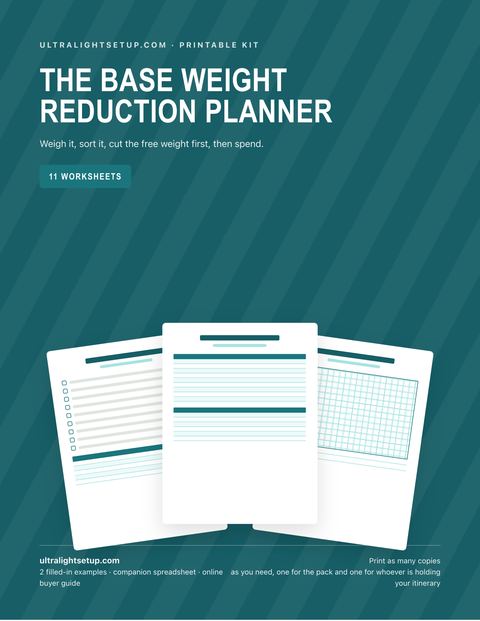
Weighing your own kit item by item? The Base Weight Reduction Planner is the paid version of these pages: 11 printable worksheets you fill in with your own numbers, two filled-in examples, a companion spreadsheet and the full PDF, $29.