Therm-a-Rest Vesper 32F Quilt Review: 15 oz, and No Back
Fifteen ounces in the regular size, 900 fill hydrophobic PFAS-free down, mesh wall baffling to spread loft, and removable straps that connect it to a pad. Buy it if you have a warm pad and want the lightest way to be warm. Understand what a quilt is first: it has no insulation under you and no hood, so your pad's R-value and your draft management do work the quilt does not, and a quilt rating is not directly comparable to an ISO-rated bag.
Nine hundred fill down at fifteen ounces, and the draft management a quilt asks you to learn.
Therm-a-Rest Vesper Quilt 32F/0C Down
Under $500
A 900 fill down quilt for minimalist backpackers and thru-hikers, at 15 oz in regular, with mesh wall baffling and pad connectors.
Check price on AmazonSpecifications
| Rating | 32 F / 0 C |
|---|---|
| Fill | 900 fill power down, PFAS-free and hydrophobic |
| Weight | 15 oz, 440 g in regular |
| Packed size | 5 x 6 in, 13 x 15 cm |
| Baffling | Advanced mesh wall baffling to minimise cold spots |
| Pad attachment | Removable ultralight SynergyLink connectors |
| Pad compatibility | SynergyLink connectors work best with regular sized pads around 3 in thick |
| Included | Compression stuff sack and storage sack |
Specifications above come from Therm-a-Rest's published specifications. Treat pricing as approximate, since Amazon pricing moves.
What it does well
- Fifteen ounces for a 32 degree quilt is genuinely light, and the sleep system is one of the Big Three where a pound saved is a pound off your base weight every day.
- Nine hundred fill down is the highest quality commonly available, which is what lets it be this light without being cold.
- Mesh wall baffling rather than sewn-through construction means no cold seams, which is where cheap quilts lose their warmth.
- Pad connectors are the difference between a quilt and a blanket. Without them, a quilt slides off in the night and you wake up cold.
- It packs to 5 by 6 inches, which changes what pack volume you need. Sleep system bulk is often what forces a bigger pack.
Where it falls short
- A quilt has no back and no hood. The insulation you are lying on would be compressed and useless anyway, which is the argument for the design, and it means your pad's R-value is doing half the work. Pair a 32 degree quilt with a warm pad or you will be cold from below.
- Quilt temperature ratings are typically manufacturer figures rather than ISO 23537 test results, so they are not directly comparable with a bag rated to that standard. Treat a quilt rating as optimistic and add margin.
- Draft management is a skill. A quilt tucked badly lets cold air in along the sides, and it takes a few nights to work out what works for how you sleep.
- The SynergyLink connectors are stated to work best with a regular-sized pad around 3 inches thick. A wide or unusually thick pad may not attach cleanly.
- Down is useless when wet. Hydrophobic treatment slows wetting out; it does not make down waterproof. In sustained damp, synthetic insulation keeps working when down does not.
What owners report
Owner reports on the Vesper are strong on weight and packed size and consistent about the same thing every quilt review mentions: the first few nights are a learning curve. People who get the strap tension and the draft tuck right describe it as warmer than expected; people who do not describe cold shoulders.
Our quilt versus sleeping bag comparison is the honest treatment, and the summary is that quilts are lighter and require more from the sleeper. Our budget versus premium quilt comparison covers whether 900 fill is worth the money, and our down versus synthetic comparison covers the wet weather question.
The number that matters most is the whole sleep system rather than the quilt alone. Our sleep system temperature calculator combines quilt rating and pad R-value, and the temperature ratings reference explains why comfort, limit and extreme are three different numbers.
Who it suits
- Hikers who already own a pad with a genuinely warm R-value.
- Anyone counting ounces on a long trail where the sleep system is a target.
- Sleepers who move around and find mummy bags restrictive.
Who should skip it
- Cold sleepers using a summer pad, where the ground will beat the quilt.
- Anyone who wants to unzip a bag and get in without thinking about drafts.
- Sustained wet trips, where synthetic insulation is more forgiving.
Alternatives worth considering
Sensory4U Ultralight Sleeping Bag Top Quilt, 850 Down, 1.9 lbs, Rated 30 F
Under $250
Eight hundred and fifty fill at a similar temperature rating for a third of the money and about half a pound more. The weight difference is real and so is the price difference, and for most hikers this is the sensible first quilt.
Check price on AmazonKelty Cosmic 20 Down Mummy Sleeping Bag, 550 Fill Power
Under $250
An ISO-rated mummy bag with a hood, at a 21 F ISO limit rating. Heavier and bulkier and far more forgiving, because a bag with a hood removes the draft management problem entirely.
Check price on AmazonTherm-a-Rest NeoAir XLite NXT Ultralight Sleeping Pad, Regular
Under $250
A 4.5 R-value pad at 13 oz. A quilt without a warm pad is a bad system, because there is no insulation under you, and R-value is what stops the ground taking your heat.
Check price on AmazonKeep reading
- Quilt vs sleeping bag
- Budget quilt vs premium quilt
- Down vs synthetic insulation
- Sleep system temperature calculator
- Sleeping bag temperature ratings
- The Big Three explained
- Therm-a-Rest NeoAir XLite NXT review
- Kelty Cosmic 20 review
- Best ultralight quilts
This review draws on published specifications, manufacturer figures and the consensus of verified owner reviews. We have not tested this product ourselves, and we say so rather than implying otherwise. As an Amazon Associate we earn from qualifying purchases.
Frequently asked questions
Is a quilt warm enough?
A quilt plus a warm pad is a system, and the system is what has a temperature. A 32 degree quilt on a 4.5 R-value pad works for most sleepers near freezing; the same quilt on a summer pad does not. Our sleep system calculator combines both figures, which is the right way to think about it.
What R-value pad do I need with a 32 degree quilt?
Something in the region of 4 or above for use near freezing, because the quilt provides no insulation underneath you at all. Below that, the ground conducts heat away faster than the quilt can retain it, and adding a warmer quilt does not fix a cold pad.
Are quilt temperature ratings comparable to sleeping bag ratings?
Usually not directly. Sleeping bags are commonly rated to ISO 23537, which specifies comfort, limit and extreme figures from a standardised test. Quilt ratings are more often manufacturer figures. Treat a quilt rating as a guideline rather than a tested number, and add margin if you sleep cold.
How do I stop drafts in a quilt?
Use the pad connectors, keep the strap tension snug enough that the quilt edges stay against the pad, and tuck the sides under your hips rather than letting them lie flat. It takes a few nights to learn. A hood or a warm hat is the other half, since a quilt has no hood.
Is 900 fill down worth it over 850?
Marginally, in weight and packed size, and it costs considerably more. The bigger differences between quilts are the baffle construction and the amount of down, not the last fifty points of fill power. Our budget versus premium quilt comparison covers where the money actually goes.
How we choose: we compare published manufacturer specifications, listed weights, and verified owner reviews across retailers. We do not test gear in person, and every weight quoted here is the manufacturer's figure unless we say otherwise, so weigh your own kit before you trust a total. Going lighter also means carrying less margin, so treat insulation, navigation, water treatment and an emergency plan as fixed costs rather than places to save grams.
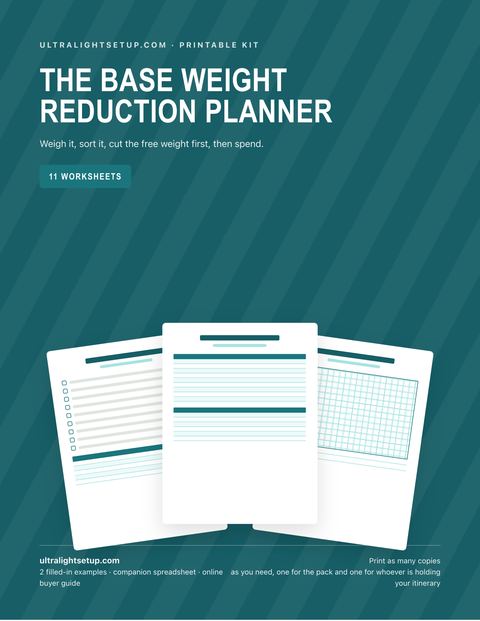
Weighing your own kit item by item? The Base Weight Reduction Planner is the paid version of these pages: 11 printable worksheets you fill in with your own numbers, two filled-in examples, a companion spreadsheet and the full PDF, $29.