Ursack Major XL Review: 8.7 oz, and Check the Regulations
Eight point seven ounces and about fifteen litres, IGBC tested and placed on the bear-resistant products list in 2014, with an integrated six foot 2,500 pound tensile cord. Buy it if the area you are going to accepts it, because it weighs a fraction of a hard canister and packs into a shape rather than being a shape. Ursack themselves say the IGBC list is relied on by many wilderness agencies but not all, so check the specific regulations for your destination before you rely on it.
IGBC-listed since 2014 and a fraction of a canister's weight, and not accepted everywhere.
Ursack Major XL Bear Bag for Backpacking
Under $500
An IGBC-listed bear-resistant sack holding about 15 litres, weighing 8.7 oz, with an integrated 2,500 lb tensile cord.
Check price on AmazonSpecifications
| Certification | Passed the Interagency Grizzly Bear Committee test and listed in 2014 |
|---|---|
| Dimensions | About 8 in diameter by 18.5 in high when cinched |
| Volume | About 925 cubic inches, roughly 15 litres |
| Weight | 8.7 oz |
| Food capacity | About 7 or more days for one person |
| Cord | Integrated 6 ft, 2,500 lb tensile strength |
| Regulatory note | Ursack state the IGBC list is relied on by many wilderness agencies but not all, and that restrictions may still apply |
Specifications above come from Ursack's published product information. Treat pricing as approximate, since Amazon pricing moves.
What it does well
- Eight point seven ounces against a hard canister at several times that. On a week-long trip that difference is one of the biggest single weight savings available.
- It packs as a soft bag, so it fills the space it is given rather than forcing your pack around a rigid cylinder. Pack volume matters as much as weight for a lot of hikers.
- About fifteen litres genuinely holds a week of food for one person, which puts it in the same capacity class as the large hard canisters.
- The integrated cord is rated at 2,500 pounds, which is the part that actually keeps the bag attached to the tree when a bear works on it.
- It has been on the IGBC list since 2014, which is a long enough track record to have been tested by real conditions rather than by a lab alone.
Where it falls short
- Acceptance is the whole review. Ursack state plainly that the IGBC list is relied on by many wilderness agencies but not all. Several well known parks require a hard-sided canister specifically, and a soft sack will not satisfy that requirement. Check the regulations for your exact destination and do not assume.
- It does not protect food from being crushed. A bear that cannot open it can still work it over, and what comes out is your week of food turned to powder.
- It only works if tied correctly. The bag must be tied to a solid tree with the right knot, and a badly tied Ursack is a bag a bear walks away with.
- Odour still escapes a fabric bag. An odour-proof liner is a sensible addition, and it is another item and more weight.
- It is not cheap for a bag. Three hundred dollars buys a large hard canister and change, and the canister is accepted everywhere.
What owners report
Owner reports on Ursacks are strongly positive on weight and packability and consistently return to the same two caveats: crushing and regulations. Hikers who use them in areas that accept them describe them as the single best weight saving on a long trip. Hikers who arrived somewhere requiring a hard canister describe an expensive lesson.
Our BearVault BV450 versus Ursack Major comparison covers the trade directly. A hard canister is heavier, bulkier, rigid, universally accepted and doubles as a camp stool. A sack is light, packable and conditionally accepted.
Food protection is also a food planning question. Our food planning guide and the food weight calculator cover how much you are actually carrying, and the calories per ounce reference covers packing more energy into less volume, which makes any container go further.
Who it suits
- Hikers whose destination explicitly accepts IGBC-listed soft sacks.
- Long trips where a week of food in a rigid cylinder dominates your pack volume.
- Anyone whose pack is small enough that a hard canister will not fit inside it.
Who should skip it
- Anywhere that requires a hard-sided canister, which includes several of the best known national parks.
- Hikers who mind crushed food, since a worked-over sack does not preserve shape.
- Anyone who will not learn and use the correct tie-off.
Alternatives worth considering
BearVault BV500 Journey Bear Resistant Food Container, Extra Large
Under $100
IGBC and SIBBG certified, and BearVault state it is approved by all National Parks and Forests with canister regulations. Heavier and rigid, and it removes the question of whether your food storage is legal where you are going.
Check price on AmazonBearVault BV450 Jaunt Portable Bear Canister, Medium
Under $100
The smaller hard canister, sized for shorter trips. Lighter and less bulky than the BV500 while keeping the universal acceptance a hard canister gives you.
Check price on AmazonSea to Summit Ultra-Sil Dry Bag, Waterproof, 13 Litre
Under $50
Listed to be clear about the difference. A dry bag keeps food dry and does nothing whatsoever against wildlife. Where bear protection is required, a dry bag on a branch does not meet it.
Check price on AmazonKeep reading
- BearVault BV450 vs Ursack Major
- Ultralight food planning
- Food weight calculator
- Food calories per ounce
- Pack volume calculator
- BearVault BV500 review
- Best bear canisters
This review draws on published specifications, manufacturer figures and the consensus of verified owner reviews. We have not tested this product ourselves, and we say so rather than implying otherwise. As an Amazon Associate we earn from qualifying purchases.
Frequently asked questions
Is an Ursack allowed everywhere?
No. Ursack themselves state the IGBC list is relied on by many wilderness agencies but not all, and that restrictions may still apply. Several well known parks require a hard-sided canister specifically. Check the regulations for your exact destination before the trip, because turning up with the wrong container can mean not being allowed to start.
Ursack or a bear canister?
A sack is far lighter and packs into any shape; a canister is heavier, rigid and accepted everywhere. If your destination accepts a sack, it is the bigger weight saving on the list. If it does not, or if you travel to varied places, a canister removes the question. Our comparison covers both.
Does it protect food from being crushed?
No. A bear that cannot get in can still compress and maul the bag. Expect crumbs rather than bars. If food integrity matters, a hard canister is the only container that preserves shape, and it is one of the underrated reasons people choose one.
How do I use it correctly?
Tie it to a solid live tree using the manufacturer's recommended knot, close to the trunk and at a height that does not give leverage. The cord and the knot are what keep it attached. Read the instructions rather than improvising, because most reported failures are tie-off failures.
Do I still need an odour-proof liner?
It is a sensible addition. Fabric does not block odour, and reducing the smell reduces the chance an animal takes an interest in the first place. It weighs almost nothing and it also keeps your food dry, which the sack alone does not.
How we choose: we compare published manufacturer specifications, listed weights, and verified owner reviews across retailers. We do not test gear in person, and every weight quoted here is the manufacturer's figure unless we say otherwise, so weigh your own kit before you trust a total. Going lighter also means carrying less margin, so treat insulation, navigation, water treatment and an emergency plan as fixed costs rather than places to save grams.
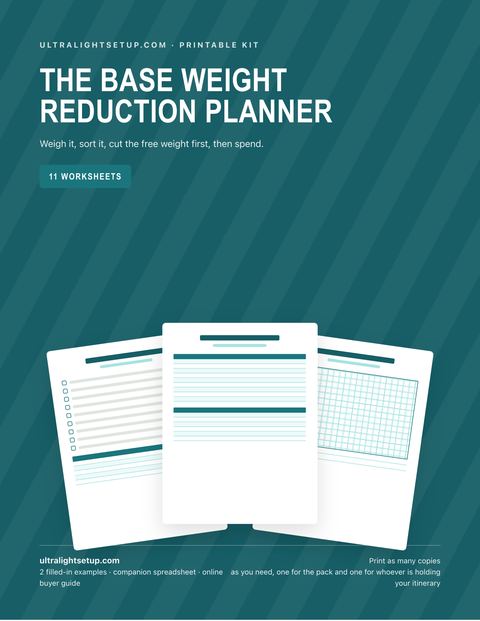
Weighing your own kit item by item? The Base Weight Reduction Planner is the paid version of these pages: 11 printable worksheets you fill in with your own numbers, two filled-in examples, a companion spreadsheet and the full PDF, $29.