Outdoor Research Helium UL Review: 15 Denier Has a Cost
Waterproof and windproof 15 denier nylon ripstop with fully taped seams, a water-resistant Aquaguard front zipper, a brim-wired adjustable hood and a jacket that packs into its own chest pocket. Buy it if you want a proper hood and a jacket you will actually carry every day. The honest weakness is the fabric: 15 denier is very thin, and abrasion against pack straps, rock and brush is what ends these jackets rather than the waterproofing failing.
A fully taped 15D shell that packs into its own chest pocket, and a fabric that will not survive a bushwhack.
Outdoor Research Men's Helium UL Jacket, Black, X-Large
Under $250
A minimalist waterproof, windproof and breathable shell in 15D nylon ripstop with fully taped seams, packing into its own chest pocket.
Check price on AmazonSpecifications
| Fabric | 100 percent nylon 15D ripstop |
|---|---|
| Seams | Fully taped |
| Zipper | Water-resistant Aquaguard front zipper |
| Hood | Brim-wired and adjustable |
| Hem | Elastic drawcord |
| Cuffs | Elastic shaped and bonded |
| Packing | Packs into its own chest pocket |
| Visibility | Reflective logos |
| Fit | Standard, hanging naturally on the body |
Specifications above come from Outdoor Research's published specifications. Treat pricing as approximate, since Amazon pricing moves.
What it does well
- A brim-wired hood is a genuine feature. A hood that holds its shape keeps rain off your face and lets you see, which soft-brimmed ultralight hoods do not.
- Fully taped seams is the specification separating a real waterproof shell from a water-resistant windbreaker. Untaped seams leak at exactly the places water runs.
- Packing into its own chest pocket means it goes in a hipbelt pocket and comes out when it starts raining rather than staying at the bottom of the pack.
- Bonded elastic cuffs seal better than a plain hem and add no bulk, and a drawcord hem stops the jacket lifting in wind.
- It weighs little enough that carrying it is not a decision, which is worth more than a heavier jacket that stays at home.
Where it falls short
- Fifteen denier is very thin fabric. Pack straps, granite and brush all abrade it, and a hole in an ultralight shell is a repair rather than a warranty claim. This is the trade for the weight and it is not negotiable.
- All waterproof breathable shells wet out eventually. Once the outer face fabric saturates, breathability collapses and you get wet from the inside. That is physics rather than a failing of this jacket, and it is why sustained rain is uncomfortable in any shell.
- The DWR treatment wears off and needs reapplying. A jacket that used to bead and now soaks is usually a DWR problem, not a membrane failure.
- Two hundred and twenty five dollars for a jacket you will eventually tear is a real consideration. There is a well known budget alternative that works, is heavier and lasts about as long.
- Minimalist means no pit zips on most jackets in this class, so venting is done by opening the front, which is not always practical in rain.
What owners report
Owner reports on the Helium family are consistent: light, packable, good hood, and the fabric is the limit. Hikers who treat it carefully report years of use; hikers who bushwhack in it report holes. Both are describing the same jacket used differently.
The comparison that decides most purchases is our Frogg Toggs versus Helium comparison, and it is genuinely close. Frogg Toggs cost a tenth as much, breathe well, weigh a little more and tear even more easily. Plenty of experienced thru-hikers use them and replace them.
The other option is our rain jacket versus poncho comparison. A poncho covers you and your pack, ventilates completely and is useless in wind. Our layering guide and the layering temperature reference put the shell in context, because a shell is a wind and rain layer rather than a warm one.
Who it suits
- Hikers who want a hood that works and a shell light enough to carry always.
- Anyone who has been caught out by a jacket left in the pack because it was a hassle to get to.
- Trips where wind is as much the problem as rain, since a shell handles both and a poncho does not.
Who should skip it
- Bushwhacking and scrambling, where 15D fabric will not last.
- Hikers who would rather spend a tenth as much and replace it, which is a defensible strategy.
- Sustained heavy rain at high exertion, where no shell keeps you dry from the inside.
Alternatives worth considering
Frogg Toggs Men's Ultra-lite2 Waterproof Breathable Rain Jacket, Blue, Large
Under $50
A non-woven jacket that is genuinely waterproof and breathes well, at a tenth the cost. It tears easily and it is disposable by design, which is exactly why many long distance hikers use it.
Check price on AmazonSea to Summit Ultra-SIL Nano Tarp Poncho, 4-in-1 raincoat, pack cover, groundsheet and shelter
Under $250
Eight point one ounces, covering you and your pack, doubling as a groundsheet or a tarp shelter. Excellent in still rain and poor in wind, which is the trade every poncho makes.
Check price on AmazonSea to Summit Ultra-SIL Dry Bag, Waterproof, 13 Litre
Under $50
No shell keeps everything dry in sustained rain. A dry bag around your sleep system is what guarantees a dry night, and it matters more than the jacket does.
Check price on AmazonKeep reading
- Frogg Toggs vs Outdoor Research Helium
- Rain jacket vs poncho
- Layering system guide
- Layering temperature reference
- Fabric denier and weight
- Sea to Summit Nano Tarp Poncho review
- Best ultralight rain jackets
This review draws on published specifications, manufacturer figures and the consensus of verified owner reviews. We have not tested this product ourselves, and we say so rather than implying otherwise. As an Amazon Associate we earn from qualifying purchases.
Frequently asked questions
How long does an ultralight rain jacket last?
It depends entirely on what you do in it. Careful use over trails and campsites gives years. Bushwhacking, scrambling and daily pack strap abrasion will put holes in 15 denier fabric far sooner. Repair tape handles small tears and it is worth carrying a strip.
Why does my rain jacket wet out?
Because the durable water repellent finish on the outer fabric wears off. Once the face fabric soaks, water vapour cannot escape and you get damp from your own sweat even though the membrane is still working. Wash the jacket and reapply a DWR treatment; that fixes most cases people blame on the membrane.
Frogg Toggs or a proper shell?
Frogg Toggs cost around a tenth as much, breathe genuinely well and tear if you look at them wrong. A proper shell has a better hood, better cuffs and lasts longer if you are careful. Both approaches are used by experienced hikers, and the honest choice depends on whether you would rather maintain gear or replace it.
Is a poncho better than a jacket?
In still rain, a poncho ventilates far better and covers your pack as well as you. In wind, it becomes a sail and stops working. If your rain comes with wind, a jacket plus a pack cover or a dry bag liner is the more reliable system.
Do I need pit zips?
They help enormously when you are working hard in the rain, and they add weight and complexity. Minimalist shells generally omit them, which means venting by opening the front. If you hike hot and steep in rain, pit zips are worth the grams.
How we choose: we compare published manufacturer specifications, listed weights, and verified owner reviews across retailers. We do not test gear in person, and every weight quoted here is the manufacturer's figure unless we say otherwise, so weigh your own kit before you trust a total. Going lighter also means carrying less margin, so treat insulation, navigation, water treatment and an emergency plan as fixed costs rather than places to save grams.
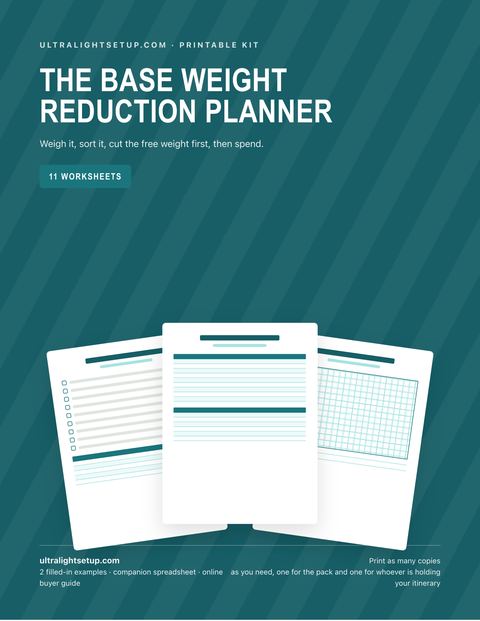
Weighing your own kit item by item? The Base Weight Reduction Planner is the paid version of these pages: 11 printable worksheets you fill in with your own numbers, two filled-in examples, a companion spreadsheet and the full PDF, $29.