Cascade Mountain Tech vs Black Diamond Distance Poles
Cascade Mountain Tech carbon poles cost roughly a third of the Black Diamond price and they do the job. What you pay more for at Black Diamond is lock reliability, grip quality and a folding design that deploys in seconds. If poles are occasional, the cheap ones are genuinely fine. If they are in your hands all day every day, the difference is in the parts that wear.
At a glance
| Cascade Mountain Tech carbon fibre trekking poles | Black Diamond Distance Carbon FLZ folding poles | |
|---|---|---|
| Shaft | Carbon fibre | Carbon fibre |
| Mechanism | Telescoping with lever locks | Z folding with a length adjustment |
| Deployment | Unclip and extend | Flick out and lock, faster |
| Locks | Adequate, can slip under load with wear | More reliable over time |
| Grips | Basic foam or cork | Better shaped, longer extended grip |
| Cost | Low | High |
Choose the Cascade Mountain Tech carbon fibre trekking poles if…
Choose the Cascade poles for occasional use, for a first pair, or if you are not sure you will use poles at all. They are carbon, they are light, and at this price a broken pair is annoying rather than painful. The lever locks are the part that shows the price: they can begin to slip under load as they wear, which is fixable by tightening but is something you will attend to more often.
Check Cascade Mountain Tech carbon fibre trekking poles on Amazon
Choose the Black Diamond Distance Carbon FLZ folding poles if…
Choose the Black Diamond Distance poles if you use poles constantly, if they hold up your shelter, or if you want them to deploy and stow in seconds. The folding design collapses short enough to stow on a pack without catching on branches, the locks are more dependable over years, and the grips are shaped for a hand that will be on them for eight hours. That is what the extra money buys.
Check Black Diamond Distance Carbon FLZ folding poles on Amazon
Related
Comparison based on published manufacturer specifications and the general consensus of owner reports. We have not tested these products side by side. Confirm current specifications and prices before buying. As an Amazon Associate we earn from qualifying purchases, at no extra cost to you.
Deciding on a specific model? We review the Black Diamond Distance Carbon Z pole review in full.
Frequently asked questions
Do cheap poles fail dangerously?
Rarely dangerously, but they fail inconveniently, usually as a lock that slips and lets the pole collapse under load. On flat ground that is a stumble. On a steep traverse it can put you off balance in a bad place. Check and tighten the locks before a trip, and treat any pole that has started slipping as needing attention rather than tolerance.
Can either pair pitch a trekking pole tent?
Both can, provided the pole can be locked at the height your shelter needs. Telescoping poles adjust freely, which is the easier case. Folding poles usually have a limited adjustment range, so check the required pitch height against the pole specification before buying, because a pole that will not reach the right height makes a tent difficult to pitch well.
Are cork grips worth it?
In hot weather, mostly yes. Cork absorbs sweat and moulds slightly to your hand over time, where foam gets slick and eventually degrades. Neither matters much on a cold day in gloves. If your hands sweat and your trips are long, grip material is a comfort feature you will actually notice.
Do poles reduce injury?
The evidence supports reduced load on the knees during descents and better balance on uneven ground and stream crossings, which is a reasonable basis for using them. They are not a treatment for an existing injury and they will not fix a knee problem. If you have persistent joint pain, that is a question for a clinician rather than for gear.
How we choose: we compare published manufacturer specifications, listed weights, and verified owner reviews across retailers. We do not test gear in person, and every weight quoted here is the manufacturer's figure unless we say otherwise, so weigh your own kit before you trust a total. Going lighter also means carrying less margin, so treat insulation, navigation, water treatment and an emergency plan as fixed costs rather than places to save grams.
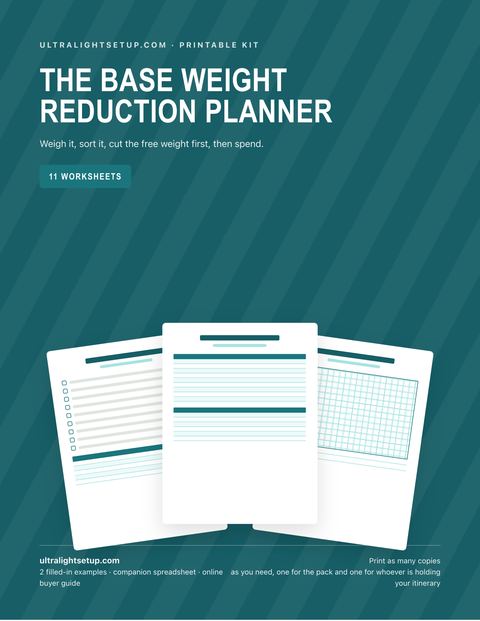
Weighing your own kit item by item? The Base Weight Reduction Planner is the paid version of these pages: 11 printable worksheets you fill in with your own numbers, two filled-in examples, a companion spreadsheet and the full PDF, $29.